
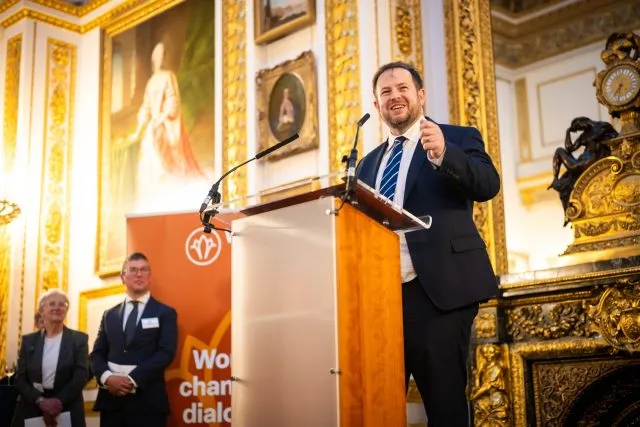
Distinguished guests, colleagues – friends,
It’s good to be with you to celebrate the 80th anniversary of an institution that has done so much to advance international co-operation and the cause of democracy.
Thanks, Tom, for your kind introduction and for your leadership of Wilton Park.
Also, Gisela (Stuart) is here somewhere as well, and thanks to you, for the dedication you bring as Chair – obviously built by a huge wealth of experience, in of course your own time in the place where I find myself now.
As someone facing all the complexities that my ministerial work brings, Wilton Park is definitely an institution that means a lot to me.
As many of you will know, it was founded by Sir Heinz Koeppler, a German who fled to Britain in 1933. This was all part of an initiative, one of a number of initiatives, inspired by Winston Churchill and how he wanted to establish democracy after the Second World War and to drive forward many values and principles that we’ve held dear since.
And during the three decades that he presided, Germans of all backgrounds came to consider how to rebuild their shattered society and think about their future within a secure and peaceful Europe.
And if I think about the trajectory, of my own family, my own relationships with Germany over many, many decades. We’re going from a family who was in the forces in the First and Second World War, and my grandfather actually taken prisoner of war, to having two German godchildren, and one was happily sending messages on my birthday yesterday. I think the transformation of the relationship between the UK and Germany should set the tone and inspiration to many generations to come. And I think what was being done at that time, rebuilding from the ashes of war and driving forward the agenda more generally, but much more broadly at Wilton Park, is hugely, deeply important to me and of course, it is deeply important to the relationship that we have today.
And of course, it is very much therefore still a place where people who do not otherwise sit together necessarily can meet, and talk in private, and speak frankly, openly about many challenges, listen to one another – and often perhaps disagree, disagree well – and work through the pressing issues we all face.
And of course it has got a huge track record of real-world impact, not just those initial conversations in the decades after World War II in relation to Germany, but of course conversations on the transition from apartheid in South Africa, helping to integrate former Communist countries into European democracy, and indeed shaping UK policies on cyber power, or dealing with the challenges facing the future of Ukraine, one of the discussions I was able to take part in powerfully last year.
But also, as a proud Welshman, I find something quite fitting about Wiston House itself. Every spring it is surrounded by daffodils and sheep, two things which are well-known to us in Wales. But of course the daffodil is also a flower of hope and renewal and that’s rather apt when it comes to the conversations that take place inside those walls, in those beautiful surroundings.
And I think today, in the world we that face: conflict, strain of adversity, uncertainty, those conversations are more valuable than ever. Because, we are of course, living through a period where some very longstanding assumptions are being tested and where many of the institutions built to manage co-operation in the post-World War II era, are under real pressure.
And whether it’s in the UK, or whether it’s across Europe, or beyond, we are confronting difficult questions about security, about democracy, about economic resilience, about climate change and the nature crisis, about technology, and how societies recover from violence and disruption, often all at once, and intersecting in many very complex ways.
And therefore, we need a place for those conversations to take place. Helmut Schmidt once remarked that Wilton Park’s contribution to international understanding cost the taxpayer less than a single modern tank – and I would hazard a guess that something along those lines would be true today. And therefore, its value is absolutely understood, certainly by this government and I know by all of you in this room.
Every year, Wilton Park brings together 80 or so international policy dialogues, bringing together officials and experts from well over a hundred countries – that’s government and opposition voices, diplomats and activists, economists and security practitioners, civil society, women’s groups, many different organisations – all coming together to test ideas, build understanding and to shape agendas. And fundamentally those are the underpinnings, the foundations of the diplomacy and the engagement that many of us have to engage with on a daily basis.
I think it demonstrates Wilton Park’s quiet and absolutely crucial contribution on the international stage.
A lot of that work is done without fanfare, it’s done by incredibly dedicated teams, and having met many of the staff at Wilton Park, I know just the effort that goes in to making sure that those conversations can take place in a constructive, quiet, passionate, but impactful way, which was absolutely clear to me.
And of course, for us as the government, this then very much underpins what we’re trying to do in relation to agile alliances, whether for example, we’ve got security stability or new departures in international development, on economic resilience, on climate, technology, protection of the values that we all hold dear – more important than ever.
I mentioned that conference that I attended with Ukrainian ministers and parliamentarians focused on economic resilience and recovery and that hope, again, about future not just the immediate challenges, and that was just the day before discussions at the Aurora Forum last year, which is also convened by Wilton Park. A crucial forum which brings together those of us across the Nordic-Baltic region for co-operation. But what stayed with me was very much the quality and the depth of the conversations that you can have – open, serious, rooted in the realities that people are facing on the ground. Being able to have those more discursive and free-thinking conversations, that certainly we as politicians are often not able to have in the confines of the scrutiny of parliament and the media, but which are absolutely as important as those conversations, allowing us to find ways forward on some of these crucial challenges.
Of course, it’s not just Ukraine where Wilton Park’s value is clear, but I am very glad that in so many areas where we face conflict, the most serious of challenges, there’s quiet conversations to find ways forward and to find hope for the future. But I also think that can apply equally to the economic discussions that we have, challenges around AI, challenges around technologies of the future, challenges of how we respond to climate and nature emergency, respond to energy security. Because those are also areas where have to have honest, frank and expansive conversations really to find the right ways forward. Because the choices that are being offered are difficult and challenging for our societies and for the world as a whole, so you need to be able to have open and honest conversations.
So as Wilton Park looks forward to its next chapter, I know it’s going to keep providing an absolutely vital space where people from all walks of life can sit down and work through issues together.
And I’m also glad that as it continues to burnish its very significant reputation and impact over 80 years, it’s also bringing more diverse voices into the room – faith leaders, business leaders, civil society, alongside governments and diplomats. Because that mix of voices is absolutely crucial to getting the right answers to the challenges that we face.
So I really just want to say a huge, huge thank you to the team at Wilton Park, to the governance at Wilton Park, and finally to all of you in the room who actually make the place function by contributing and taking part. And those of you in the room who perhaps haven’t been I very much hope over this year and the next few years that you do get a chance to take part in those conversations there.
Thank you very much.
Speech as delivered 16/04/2026