
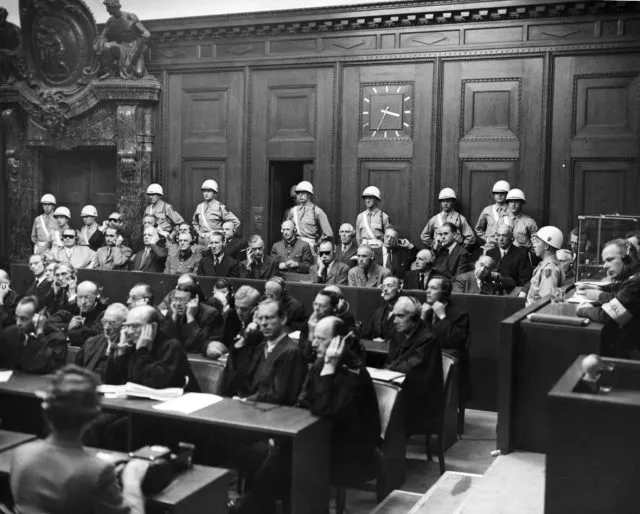
It all started with Nuremberg.
When, following a defining moment of transition, the victorious Allied powers of Britain, France, Russia and the USA heeded American prosecutor Robert H. Jackson’s call to ‘stay the hand of vengeance’, foreign actors took control of how the German Transitional Justice process would operate. Former politicians, generals, officials, and industrialists of the Third Reich would face a range of charges at an international military tribunal, delivered by prosecutors from Allied nations. It would not be until years later that the Germans themselves were trusted with delivering justice for the crimes of the Nazis.
Around the same time, and hidden from the world’s attention, an education camp for German PoWs opened in England’s Home Counties, at which informal lectures and discussions were convened on democracy, liberalism, and human rights. This was Wilton Park. Its founder, Jewish-German émigré Sir Heinz Koeppler, believed in the power of dialogue to bring about a peaceful and democratic post-war Germany. Therefore, while punishment of the most severe crimes was necessary, he argued the focus should lie on reconstruction and, especially, education. With its discursive format and comfortable setting at Camp 300 in Beaconsfield, Wilton Park sat in stark contrast to the austerity and formality of Courtroom 600 in Nuremberg.
From Nuremberg to the world
Both Wilton Park and the Nuremberg tribunal opened shortly after the signing of the UN Charter in June 1945, and in the next few years, incredible advances would be made in multilateralism and human rights, with the Universal Declaration on Human Rights in 1946, the Genocide Convention in 1948, and the Geneva Conventions in 1949. The Nuremberg Principles were formally formulated in 1950 by the UN International Law Commission (ILC), turning the legal lessons of the trials into enduring principles of international criminal law. Individuals, including state leaders and officials, would thereafter be held personally responsible for the gravest crimes. By casting human rights as universal, and responsibility for international crimes as individual, the foundations were laid for international involvement in delivering justice.
Of course, what immediately followed was almost 40 years of paralysis, as the Cold War made it impossible for the major powers to reach consensus on who had committed atrocities. However, in the mid-1980s, as dictatorships began to crumble in South America and Eastern Europe, accountability for abuses became a feature of transitions to liberal democracy. This ‘justice cascade’ continued through the iconic 1990s Transitional Justice moments in Rwanda, Former Yugoslavia, South Africa, and Northern Ireland. By this time, consensus around ‘international’ crimes was such that there was widespread global support for the creation of a permanent International Criminal Court (ICC), to be based in The Hague, somewhere between Nuremberg and Wilton Park’s new home in Sussex.
This upsurge in international energy behind justice and human rights was naturally reflected in Wilton Park’s broader programme of dialogues: in July 2001, it convened “Justice in Africa”, quickly followed by “Towards Global Justice: Accountability and the ICC” in February 2002, and “Post-Conflict Justice: Lessons for the Future”, in 2003.
In 2005 Wilton Park convened a dialogue on “Transitional Justice and the Rule of Law in Post Conflict Societies: The Role of International Actors”, examining the relationship between peace and justice, the role of truth commissions, domestic judicial reform, and specifically the role of international actors in supporting national processes.
While the justice theme continued in the following years (2008’s “Pursuing Justice in Ongoing Conflict: Examining the Challenges”, 2010’s “Negotiating Justice: The Challenge of Justice and Accountability in Peace Negotiations” and 2013’s “Integrating Transitional Justice, Security and Development”), this 2005 event provides a particularly interesting point to reflect on, more than twenty years on.
2005: the age of transformation
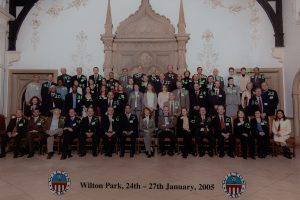
Sixty years after Nuremberg, the supremacy of the liberal order was without serious challenge. International rivalries did not prevent universal condemnation of Al-Qaeda’s actions on 9/11 and broad acquiescence to the US and its allies’ overseas actions in response. There seemed to be no serious alternative to democracy, and the UN Security Council could still generally be relied upon to work in defence of international security. In the summer of 2005, a meeting of G8 leaders (including youthful Russian President Vladimir Putin) would agree to cancel 100% of eligible debts owed by heavily indebted poor countries, launching a package of measures to increase aid and support progress towards the Millennium Development Goals.
This signalled a world order in which it was expected that major powers would intervene in the affairs of less-developed nations to support both economic development and human rights. The complementarity principle of the ICC can be seen as an extension of this idea – if crimes against humanity, war crimes or genocide could not be prosecuted in the jurisdiction in which they had taken place, then an international body could be called upon to intervene and deliver legal justice. In parallel with the ICC, ‘hybrid’ courts were created in which Western donor support provided technical expertise and financial support for domestic courts to try leaders guilty of international crimes. In 2004, a seminal UN Secretary-General report on ‘The rule of law and transitional justice in conflict and post-conflict societies’ underlined the need to ensure international legal standards for justice, while accommodating local traditions.
This international backdrop naturally frames the report from the 2005 Wilton Park dialogue, which was supported by the recently-founded International Center for Transitional Justice (ICTJ), a US-based (and largely European-funded) NGO. The opening sentence reflects that “During the past twenty years, there have been significant advances in human rights doctrine”. It acknowledges the UN Secretary-General’s 2004 report, and asserts that “international actors [should] continue to examine how best to promote transitional justice and the sustained rule of law in post-conflict societies, and how their efforts can be better coordinated”.
Of course, Transitional Justice is fundamentally a story written by domestic actors – without the persistent activism of local groups of victims, survivors, and their families and communities, there would be no trials, no truth-telling, and no accountability – and the 2005 event report offers a thoughtful but unapologetic call for international actors to play a role “of solidarity, not substitution”. It continues: “International actors should supplement resources, comparative information, and expertise where needed…they must be diligent in supporting local empowerment, while ensuring the application of international law and standards.” This role must also extend beyond state-to-state relations: “strategic planning and coordination [of TJ processes] also requires international actors to maintain sufficient dialogue with local civil society in order to identify the key issues around which they can collectively act.”
Furthermore, the ‘international community’ (as imagined in 2005) had “a responsibility to communicate a message of accountability at the very beginning of its involvement with a country, sending a message to violators and the general public that the cycle of impunity must be broken. … Any such wavering in international attention and commitment can negatively impact justice and rule of law measures.”
What to make of this sense of international responsibility, another twenty years on? The expectation in 2005 was clear: justice would remain a priority of the ‘international community’, including financial support through growing levels of official development assistance. To some degree, this millennial optimism was well-founded – overall levels of development assistance from OECD-DAC donors would continue growing until reaching a peak in absolute terms in 2023, at approximately USD 224 billion.
The Sustainable Development Goals, launched in 2015, included a provision for “access to justice for all, and effective, accountable and inclusive institutions” (SDG 16: peace, justice and strong institutions). International justice actors argued that SDG 16 provided a framework for Transitional Justice, and by 2019, a Working Group on Transitional Justice and SDG16+ was explicitly articulating how justice contributes to SDG 16 and related goals on gender and inequality.
A crumbling order
This progress and consensus on international justice arguably continued right through to 2022, when the international community responded with alacrity to Russia’s full-scale invasion of Ukraine with a well-supported (in the West, at least) referral to the ICC, and the prompt issue of arrest warrants for President Putin and Children’s Minister Maria Lvova-Belova.
However, the post-WWII foundations that had nurtured this justice generation were already weakening. The US-led Global War on Terror had resulted in widespread human rights abuses, as the US (which had signed but not ratified the Rome Statute creating the ICC) prioritised its need for security above all else. The ICC itself had struggled to deliver justice either at scale or at pace, drawing into question its validity. Justice processes for atrocities in places such as Iraq, Afghanistan, and Sri Lanka had either stalled or not started at all.
An even greater challenge was still to come. When the 7 October 2023 Hamas terrorist attacks took place in Israel, precipitating extensive Israeli violence against civilians in Gaza, Western leaders were noticeably less willing to call out the commission of international crimes, and ICC arrest warrants for Hamas leaders and senior Israeli politicians were met with reactions ranging from outrage (Israel, the US, and Hamas themselves), to quiet concern (UK Prime Minister Rishi Sunak called the warrants “deeply unhelpful”).
From this point on, funding for the ICC – and indeed wider development funding – from European powers has declined, in light of urgent national defence requirements and domestic economic difficulties. The UN Security Council has become paralysed by the permanent presence of Russia, a prolific perpetrator of atrocities, and China, which quietly supports Russia’s invasion. The US, meanwhile, dismantled much of its international development aid apparatus in 2025, including the State Department Office for Global Criminal Justice. In 2026 the US both threatened and committed military actions widely seen as outside of international law.
New giants of justice?
So where does this leave us in 2026? Can the ‘international community’ still meet the obligations it signed up for after World War II, and developed over the following decades?
For Wilton Park, the 80-year commitment to dialogue and reconciliation remains. Having convened a dialogue in 2025 on the pursuit of criminal accountability for Ukraine, we will once again draw together international justice-seekers in July to discuss the relationship between Transitional Justice and conflict resolution. We look forward to working with the ICTJ and the International Nuremberg Principles Academy (an independent German foundation dedicated to promoting the legacy and relevance of the Nuremberg Trials through research, education, and dialogue), as we do so.
We will examine how Transitional Justice measures – accountability, truth-telling, reparations, guarantees of non-recurrence – have historically paved the way for lasting peace, and remain fundamental to how contemporary conflicts are resolved. In doing so, we will acknowledge that the ‘international community’ in 2026 looks quite different, with emerging mediation actors wielding influence as peace makers and norm-setters; these actors, and their visions for justice, will be central to our discussions.
From ‘victor’s justice’ to victims’ justice
As Western powers cut their commitments to international development and to international justice, there is growing global concern that a culture of impunity – an ‘age of monsters’, as Antonio Gramsci put it – is upon us. However, it may be that a diverse allegiance of traditional and emerging powers will rise up to take the place of the post-WWII pioneers and support local justice movements around the world. A number of cases recently put to both the ICC and the International Court of Justice – another post-WWII creation – suggest that commitment to justice remains both current and global.
Just as in the very early days of 1946, Wilton Park’s commitment to trusted and discreet dialogue – as well as to conversations that make an impact in the world – remains. We look forward to convening a dialogue that both reflects and shapes the world we live in, to make it more peaceful and just for the victims of aggression and atrocity everywhere.
Read Sam’s previous blog on transitional justice here: Standing on the shoulders of giants – international justice in an age of global rivalry
Main image: The defendants of the Trial against Major War Criminals in Nuremberg. Picture credit: National Archives, College Park, MD, USA