
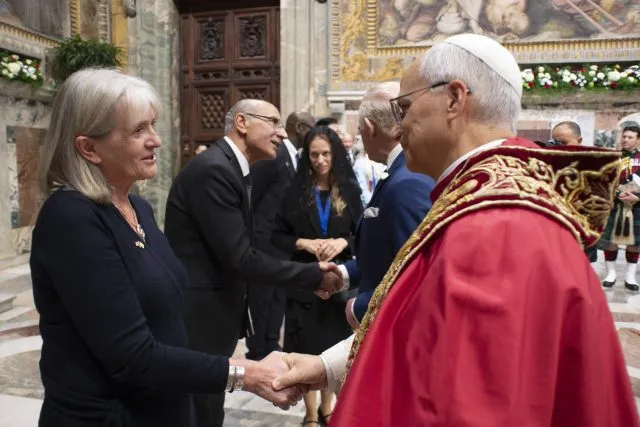
I was honoured to be at the Vatican when history was made last week, as Pope Leo XIV and King Charles prayed together in the Sistine Chapel – the first time in 500 years that a reigning British monarch has prayed publicly with a Pope since the Protestant Reformation.
For me, the moment was personal and deeply symbolic.
I grew up during the Troubles in Northern Ireland, a period of sectarian strife often simplified as a conflict between Protestants and Catholics. Certainly, the early days of the Troubles were marked by the Civil Rights movement calling for Catholics to have equal rights in voting, housing, education and jobs. Such discrimination had a long tail stretching back to Henry VIII’s seismic break from the Roman Catholic Church in the 1530’s with Catholics persecuted and often killed for their faith
And today, reconciliation between both the Protestant and Catholic communities in Northern Ireland is still unfinished business, decades after the 1998 Good Friday agreement brought a welcome end to violence.
It’s why gestures of reconciliation are still important. King Charles’s mother, the late Queen Elizabeth II, led another deeply symbolic gesture of reconciliation when, in June 2012, she walked from my home church in Enniskillen, the Church of Ireland’s Protestant St Macartin’s Cathedral, across the narrow street to the town’s Roman Catholic church, St Michael’s. The majority of the faithful of each congregation had never set foot inside each other’s religious building and, in turn, it was the first time the Queen had ever entered a Roman Catholic Church on the island of Ireland.
It was a big moment – affirming what united two denominations of the same faith and what Christian reconciliation had to say to sectarian narratives of hate and division – especially symbolic in a town where 11 people were killed during a Remembrance Day service in November 1987. It was a simple act of faith, far from the protests I often heard from prominent Protestant clergymen when I presented BBC Northern Ireland’s religious affairs programme, that a united Ireland would lead to Rome Rule, accusing the Pope of being the ‘Antichrist’ and the ‘Whore of Babylon’.
I was privileged to be in the Vatican for last week’s equally historic moment of reconciliation and to be introduced to Pope Leo and King Charles in the Apostolic Palace’s Sala Regia following the service in the Sistine Chapel. A small group of us spoke to the two leaders about environmental protection, which was the theme of the ecumenical service.
I was there to mark my engagement with interfaith work on climate change. Working in partnership with The British and Italian Embassies to the Holy See, I led conversations with key faith leaders from around the world that resulted in a 2021 Joint Appeal. Launched in the Vatican by Pope Leo’s predecessor, Francis, the appeal saw leaders from 10 different religious traditions recognise how we are all caretakers of the natural environment and how we all have a moral obligation to co-operate in the healing of the planet. We are all, they said, deeply interdependent with each other and with the natural world, and they committed themselves to taking far reaching environmental action within their own institutions and communities.
The appeal gave birth last year to a new initiative, The Women, Faith and Climate Network, funded by the British and Irish governments. The Network’s first meeting will be at Wilton Park in March next year, bringing together women of faith who are already at the forefront of grassroots responses to climate change, leading efforts in reforestation, renewable energy or disaster preparedness. It’s been a privilege to bring together wonderful groups of women of faith such as the Mothers’ Union with its over 4 million members in 83 countries or the Buddhist Tzu Chi foundation with its 6 million women – all working together to combat climate change.
This is the power of interfaith work to unite around a common cause – care of our common home. It’s work born out of that realisation that climate change threatens us all alike and that there’s more that unites us than divides us.
And so last week’s historic moment of prayer in the Sistine chapel is another step in that journey. Climate change, of course, doesn’t differentiate between someone being a Protestant or a Catholic- or a Hindu or a Muslim or for that matter, of faith or none. Its message of unity is a simple one: that only by working together with our fellow human beings can we save our common home. Last week’s moment in the Sistine Chapel was a public and powerful way to make that point.
I’d like to think that the late Queen Elizabeth II and the late Pope Francis would have been smiling.