
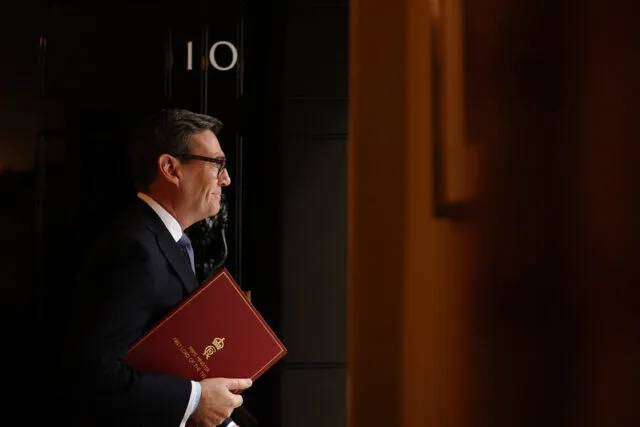
The July Cabinet Statement on Rewiring the State was the first major statement of intent published by Prime Minister Burnham’s government, and reflects his vision for a new model of government which radically shifts power towards local people and local leaders around the UK.
At first glance, devolution may appear to have little to do with the UK’s place in the world – our diplomatic, trade or security relationships. Certainly, such issues will formally remain ‘reserved matters’ to be led by Whitehall departments on behalf of the elected government of the day. Yet, having worked for many years with communities and stakeholders around the UK to understand their international priorities and perspectives, it is clear to me that the drivers which Rewiring the State both reflects and will potentially accelerate, mean that a shift in the way the UK connects the local, through the national, to the global and back again is inevitable – indeed already underway. The challenge for us all is how to ensure these changes are managed in such a way as to preserve both trust and coherence, but also resilience and integrity, in a world where a growing number of threats would undermine all of these.
Traditionally, despite points of significant domestic dispute, there has been a remarkable degree of consistency and consensus across much of the UK’s official foreign, trade and security policy. Yet beyond Whitehall the UK possesses a significant – in global terms exceptional – number of organic international links and sources of influence in its business, campaigning, faith, sporting, cultural, scientific, academic, media, diaspora and other communities.
These regional and devolved links to the international are often most visible and tangible in the growing number of business and trade initiatives being developed by cities and regions around the UK. The growing need to attract investment based not only on economic fundamentals, but on a distinctive sense of place, is also drawing ever more parts of the UK to consider their wider international profile and activities. This in turn is driving ever greater collaboration between local government, business and other local place-based organisations with global links such as universities, sports clubs and cultural institutions.
This deep, rich and varied array of non-governmental global connections has contributed significantly to the UK’s global profile, influence and relevance, and become proportionately more important in sustaining the UK’s global relevance as formal governmental structures and departments such as the FCDO have become smaller and more stretched. This is important, because too often there appears an internal assumption that government, including the FCDO, is the major or most important voice or face of the UK internationally when in fact on certain issues, and perhaps even in totality, it may be neither of these things.
Whether this is true or not, a failure by government to understand and engage with the full range of stakeholders with active international interests around the UK risks both reducing UK influence and, in some cases, undermining it, through incoherent and contradictory national voices. This is particularly true as this dispersal of influence away from formal structures in the UK is only part of a far wider global diffusion of power to non-state interests and actors.
By embracing and shaping this trend, the UK has an opportunity to build on our strengths and be more influential on certain issues where key, globally influential national bodies, stakeholders and individuals can be deployed in coordinated fashion. In a democratic society such coordination is not a given and will have to come through contested dialogue, which may be difficult and will not always deliver agreement. But the benefit of such a coordinated approach, beyond additional impact, is a more genuine sense of agency and mutual responsibility across the UK, and a more widely appreciated relationship between vast, often distant global forces and the immediacy and intimacy of local communities.
The alternative is a Whitehall ever more remote from the citizens it serves, making decisions in ever greater isolation and, potentially, of dwindling relevance. Perhaps most importantly, a national government that retreats into itself leaves communities ever more exposed to the monumental and dynamic global forces that are increasingly shaping our world. Critics would argue this is in fact what has happened amidst the unprecedented political turmoil in the UK of recent years. States and non-state interests have increasingly engaged in ‘sub-state diplomacy’, bypassing national government entirely to deal directly with local and regional actors.
Rebuilding more local and place-based economic and political models after decades of increasing exposure to global forces will require an ambitious international, as much as national and local, set of strategies, in a world where state capacity is already stretched. The need to compete for trade and investment from large global companies attracted by scale and simplicity, against foreign countries, regions and global cities of tens and hundreds of millions of people, means the international narrative on the move to more local and regional decision making in the UK will need to be carefully shaped.
So ‘Rewiring the State’ implies an ambitiously radical shift in how Whitehall engages across the UK on international issues as much as local. The FCDO can and should lead on formal government-to-government process. However, it should increasingly be considered the preeminent curator, convenor and, where necessary, coordinator of all the UK’s international links and influence.
This includes working not only with departments such as MOD, BIST and DCMS, but increasingly across Whitehall and with bodies such as the National Economic Council. In particular, it implies an FCDO that is far more domestically present, connected and informed on the varied international points of connectivity and influence across the UK, supporting and coordinating local, regional and devolved aspirations in an increasingly interconnected world.