
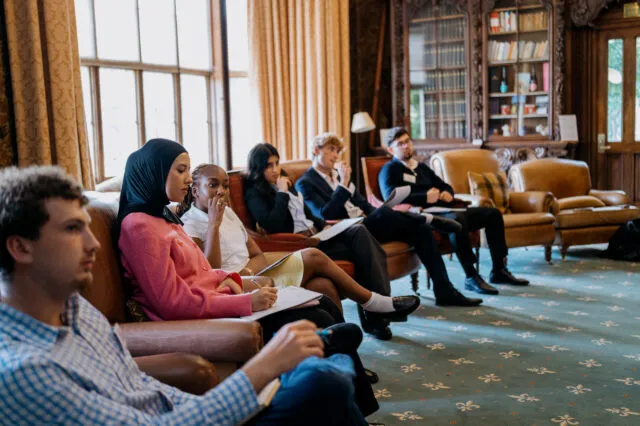
This week, the University of Nottingham cohorts of our 2026 Youth Ambassador Network (YAN) are hosting their on-campus, Wilton Park-style dialogues.
The Youth Ambassador Network was developed by Wilton Park as part of our commitment to making international dialogue more diverse, more inclusive, and more representative of the world we are working to improve.
This year’s YAN brings together 20 students from the University of Sussex and the University of Nottingham to reflect and engage on some of the most important questions facing the international community today, as well as gain the skills, knowledge and networks to engage with and contribute to collaborative solutions to pressing global issues through learning opportunities and meaningful exchanges with experts, policymakers and peers.
As part of the YAN programme, working directly with Wilton Park’s team, Youth Ambassadors are learning about, and in turn crafting policy dialogue as a tool for addressing global challenges.The students from the University of Nottingham have divided into two groups to host two separate on-campus dialogues . Here are their summaries of their programmes:
Dialogue 1: Wednesday 11 November
How can democratic societies protect election integrity in a rapidly changing technological landscape, without undermining public trust and democratic resilience?
Hosted by Luke Labuschagne, Zack Matykiewicz, Geetanjali Sasapu, Toni Serban and Amelia Walpole.
Social media is reshaping electoral information environments, creating opportunities for foreign interference and disinformation. Recent Moldovan and Romanian elections illustrate such vulnerabilities and raise important questions globally regarding the need to strengthen election security, whilst maintaining personal freedoms and public trust.
We will convene handpicked students, a professor of international security, a senior political and media literacy policy practitioner, and a civil-society representative with experience of Romania’s political landscape to draw on each other’s perspectives. We aim to assess what existing responses can teach us, identify where current approaches are lacking, and develop practical policy recommendations to strengthen election security, whilst maintaining democratic resilience.
Dialogue 2: Thursday 12 November
Technology-facilitated gender based violence: the rise of AI and emerging image-based threats to women
Hosted by Raheem Cabdiraxman, Claire Crompton, Rimsha Fayaz Sofi, Miranda Geller de la Torre, Asra Zubair
Our dialogue is titled: Technology-facilitated gender based violence: the rise of AI and emerging image-based threats to women. When planning first began, we were all keen for AI to feature, given its prominence across news stories and featuring frequently in discussions within both academia and daily life. It’s a very timely issue, and gender-based violence was also a key theme we felt passionate about, and so we decided to combine the two!
We are bringing together students, staff and academics from across a variety of subject areas, including Politics and International Relations, Geography, Law and Sociology.
The dialogue will focus on technologies like smart glasses, deepfakes and image-generation systems that are being incorporated into large-language AI models. Initial discussions will be inspired by our three speakers, who will share their experience and opinions on AI’s use in gender-based violence.
Our breakout rooms will feature case study discussions and reconvene to compare different approaches and identify common themes. Weare aiming to come away from the dialogue with 2-3 key recommendations that the University of Nottingham and other higher education institutions can introduce to reduce these risks and help victims. We aim to identify participants who will take these proposals forward to create real change, and we will create a short action note after the dialogue summarising this.