Turning dialogue into action
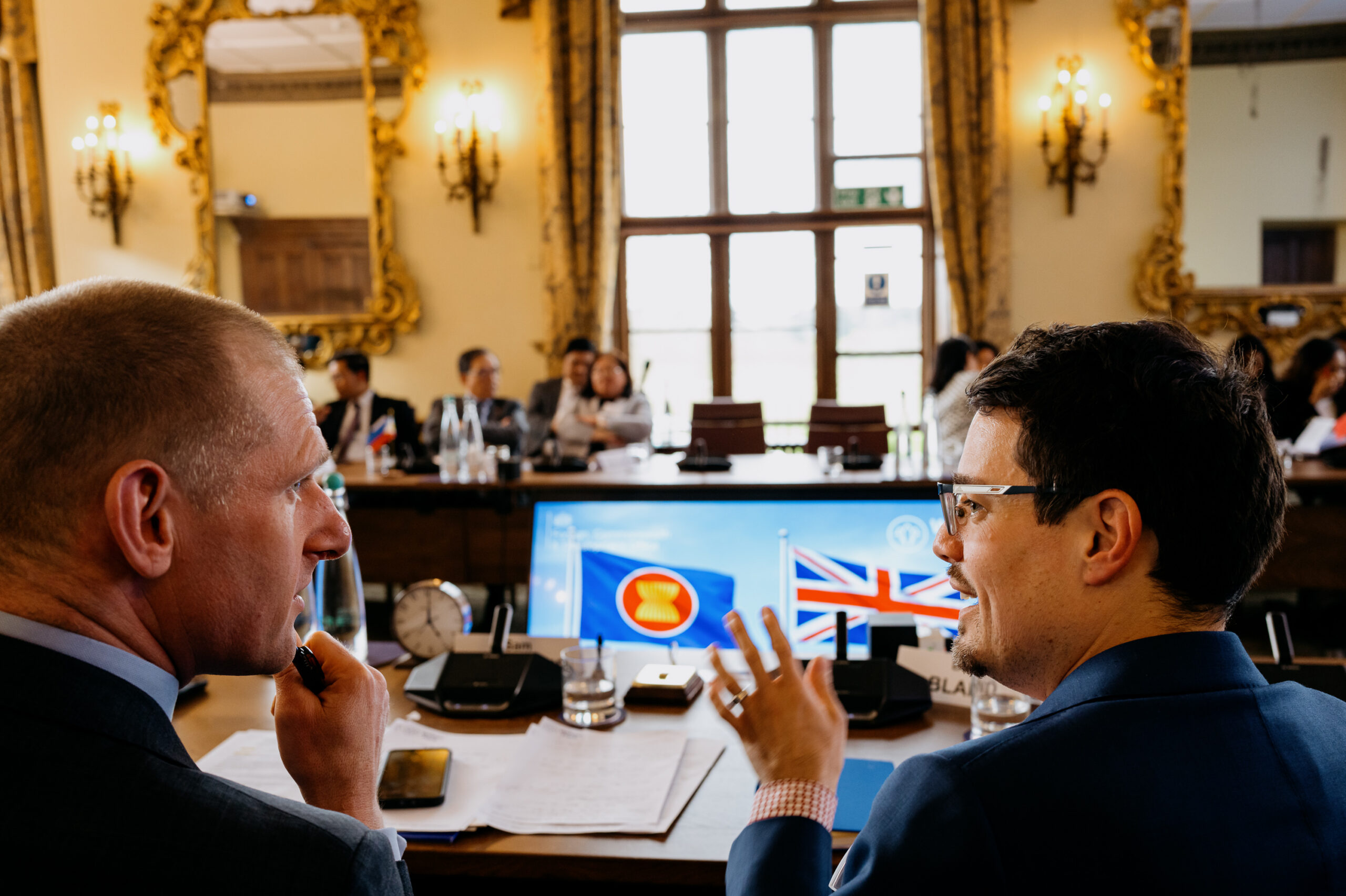
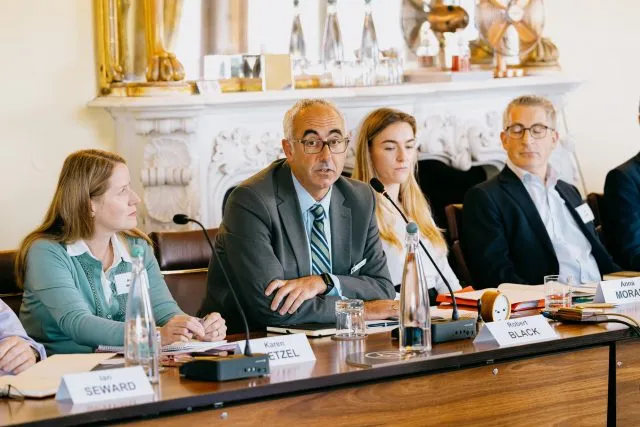
Wilton Park brings together decision-makers from around the world to address critical shared challenges and turn ideas into action.
But bringing people together is only the beginning. We want to understand what happens afterwards – whether new relationships endure, ideas turn into activity, collaborations develop, and conversations ultimately contribute to changes in policy and practice.
Our approach to monitoring, evaluation and learning helps us understand that contribution. We follow the outcomes of our dialogues over time, gather qualitative and quantitative evidence, and use what we learn to strengthen our future work.
How we understand impact
International policy change is complex. A new policy, partnership or international agreement rarely results from a single meeting or initiative. That is why we focus on understanding our contribution to change, rather than claiming total attribution for it.
Our Theory of Change helps us understand the journey from a Wilton Park dialogue to longer-term outcomes. In the short term, that might mean participants encountering new knowledge and perspectives, establishing relationships or building trust. Over time, those foundations can help create stronger policy networks, greater cooperation, practical recommendations and new approaches to shared challenges.
Ultimately, we want our work to contribute to substantive change – stronger international partnerships, improved policies and initiatives, and the mobilisation of knowledge, expertise and networks to tackle global challenges.
Impact examples
Monitoring impact over time allows us to understand how relationships and ideas formed at Wilton Park develop beyond the initial dialogue. We study the impact of our dialogues and keep in touch with partners and participants for at least two years following a Wilton Park event. This allows us to build a picture of how policy impact develops and the factors which influence it.
From dialogue to policy development
A Wilton Park dialogue brought together international expertise to explore how governments, investors and businesses could address modern slavery while supporting sustainable economic development.
When we followed up afterwards, a participant told us that evidence, international perspectives and examples shared at Wilton Park had subsequently been used to strengthen stakeholder engagement around modern slavery legislation in their country. These insights have now been included in law in their country.
Insights from the dialogue were also taken into workshops with partners who had previously been cautious. The participant reported greater stakeholder engagement and that several agencies committed to piloting a shared co-design framework rather than developing separate approaches.
They told us: “sharing the Wilton Park examples helped reframe co-design. As a result, stakeholders demonstrated a much stronger buy-in, and several agencies committed to piloting a shared co-design framework rather than developing siloed approaches.”
This is just one example of the pathway our monitoring seeks to identify. Knowledge exchanged during a dialogue being applied to a real-world policy challenge.
Strengthening international resilience
The influence of a dialogue can continue long after participants leave Wilton Park. Often the impacts compound over time.
Following a Wilton Park discussion on the future of defence, deterrence and resilience, our longer-term evaluation found that ideas developed through the dialogue had influenced the design of a major initiative from a defence alliance, focusing on an international resilience exercise involving around 200 participants from 20 countries.
A framework developed during breakout discussions at Wilton Park, exploring connections between economic resilience, energy security and critical infrastructure, subsequently became part of the conceptual foundations for the exercise.
They told us: “these insights collectively helped ensure that [the exercise] addressed not only the military dimension of resilience but also the broader societal and economic foundations that underpin deterrence and defence.”
This is one reason we evaluate impact over the longer term. The significance of an idea may only become apparent months or years later.
Building lasting international collaboration
Some outcomes take even longer to emerge or continue to develop well into the future.
In 2015, Wilton Park convened international experts to discuss human rights and major sporting events. The dialogue helped build consensus around the need for an independent organisation focused on integrating human rights into major sporting events.
The process eventually contributed to the establishment of the Centre for Sport and Human Rights. As William Rook, Chief Executive and Chief Operating Officer of the Centre, later reflected:
“We talk often about the 2015 Wilton Park meeting that kick-started a process that eventually led to the Centre for Sport and Human Rights being launched.”
It demonstrates an important characteristic of Wilton Park’s impact. Our role is often to create the conditions in which relationships develop, ideas can be tested and collective action becomes possible. Investment in dialogue can pay dividends over many years.
Turning knowledge into practical action
Impact does not always take the form of a new policy. Sometimes bringing together people with different experiences and expertise provides the knowledge needed to solve a practical problem.
A Wilton Park dialogue exploring artificial intelligence and knowledge management in evaluation brought together organisations developing and experimenting with AI tools.
When we followed up a year later, one participant reported that those conversations had contributed to subsequent work within a ministry of foreign affairs to develop an AI tool designed to synthesise evaluation evidence.
They said: “it was something that we had been considering internally but did not have the knowledge on how to approach it. This came through the interactions at the event.”
Wilton Park did not develop the tool. Instead, our contribution was to create the environment in which knowledge and experience could be exchanged, relationships established and ideas developed. By bringing together the right people at the right time, and providing expert facilitation, we help people unlock progress.