
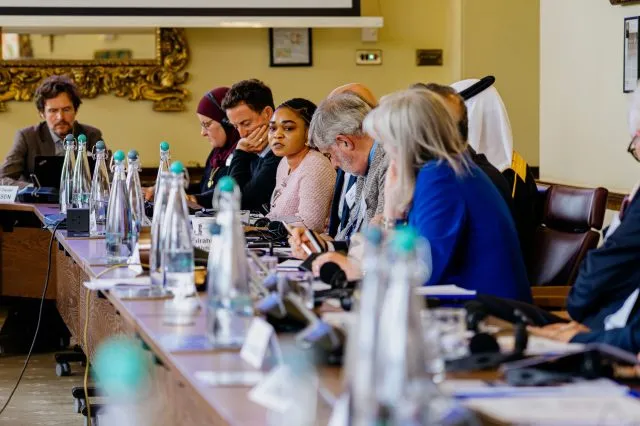
Speaking before our event, Senior Programme Director Alison Hilliard emphasised how necessary a new Global Alliance for peace is. Alison spoke of how the alliance is, in part, inspired by Pope Leo’s recent call for people who believe in peace to stand up against war, and how it is rooted in a simple but powerful conviction: that every human life is sacred, and everybody deserves dignity and justice. Watch the video below, and read more from Alison here.
In this video playlist, participants discuss how those most affected by conflict are rarely present at decision-making and negotiation tables, and why this must change. The growing threat posed by dehumanising narratives and the increasing militarisation of international relations is examined, with contributors highlighting how violence is becoming dangerously normalised. Participants reflect on the importance of creating safe spaces where people can share grievances, hopes and differing views without fear. All participants emphasise that the lessons learned by local peacebuilders on the ground must be translated into the policies that shape their lives, stating that this moment in history represents a powerful call to action for humanity to work together.
Fadi Daou (Executive Director, Globethics), Dr Chinmay Pandya (Chairman, South Asian Institute for Peace and Reconciliation), Stella Allah (Advocacy Manager, Tearfund UK), and Lord Alderdice (Director, Centre for the Resolution of Intractable Conflict) discuss the key points.
Transcriptions
Alison Hilliard
The new Global Alliance for peace is one way of getting people together, whether it’s parliamentarians, whether it’s civil society, whether it’s peace activists, or whether it’s faith leaders who all want to say that it is not inevitable that war takes place. Pope Leo put it in a very powerful way recently, when he said it was time for people who believe in peace to come together, to stand up and to say, we’re against the madness of war and we’re for peace. This seems a time when people are saying that war is inevitable, that actually violence is the only answer. It seems to be a time when people have forgotten the suffering that war causes. So this new Global Alliance for peace comes out of that desire from the silent majority of people who support peace, to say there is another way, and we want to show that there’s another way to live together, another way to say that every human life is sacred, that every human life has value, that everybody deserves dignity and justice.
Fadi Daou
Dehumanisation of the other is a serious problem for peace. Nowadays we are facing two huge problems in relation to peace, on the one hand there is an increase in dehumanising narratives of the other in many conflicts. And on the other hand the militarisation of international relations. So considering that violence as a political tool, it’s becoming unfortunately normalised. And those two realities are deeply threatening the concept of peace itself and the concept of living together peacefully within societies and between nations. So my hope is this alliance becomes a platform, a safe space where people can disagree, to have a space where people can safely share their grievances, their views and also their hopes.
Dr Chinmay Pandya
For long we have lived fragmented, divided, fractured. But now may be the time where people really have to work together. I would cite something that Gurudev said in 1987, in a famous book called Problems of Today Solutions for Tomorrow, and he said that current times may look dark and gloomy, but they should not bring fear or despair to us. Rather, we should embrace them like a call of action, because they are a sign that we are born at a special time. We are born at a time when everyone has been called to accomplish something that was never accomplished before. We cannot fight the battle on our own. We have to fight together. So I believe that is the message, that for long we have lived fragmented, divided, fractured. But now may be the time where people really have to work together. And history has provided powerful lessons like after the devastation of the Second World War, nations realise that dialogue and cooperation is important for the future of humanity. So who knows? This may be the sign for that to happen again.
Stella Attah
There is no peace building without hearing the voices of everyone. Unfortunately, that is not the reality. Those who are most affected by conflict are rarely at the decision-making tables, are rarely at the negotiation tables. And so what that means is that decisions are made about children, about women, who are most affected and those most marginalised in the community, without them. There are people in the communities that are working every day, recognised or unrecognised, formally or informally, working to build peace. And most of them are women, they should be part of the peace-building process. So inclusivity, a building block for peace. In this new alliance, one of the things that I think we’ve established is that we shouldn’t put so much burden on the local peace actors. They are doing so much already. I think the dots we need to connect, the gap there, is how to translate the learnings from the ground to the decision-making spaces. That’s where this alliance comes in, to support local actors, peace actors, working on the ground every single day, who are most affected by conflict, to ensure that the learning is translated to inform policies that affect them.
Lord Alderdice
Why is working together for peace in a different way crucial and timely? War has changed dramatically, not in terms of its nature. But the character of war has changed dramatically. Powerful nations no longer win wars, but they can create awful destruction. And we have a dissolution of the structures that provided a sort of stable instability in the global order. If we can agree on not killing each other — and the first step towards killing other human beings is stopping thinking of them as human beings, stopping speaking about them as human beings as the first step to destroying them — if we can hold to that, then that is an important place for us to start. There is a degree of transcendence, and looking at how we share as human beings that sense of transcendence — that which goes beyond us, our people and our community to the wider world and global community — would be a focus that might contribute to some kind of better ambition.