
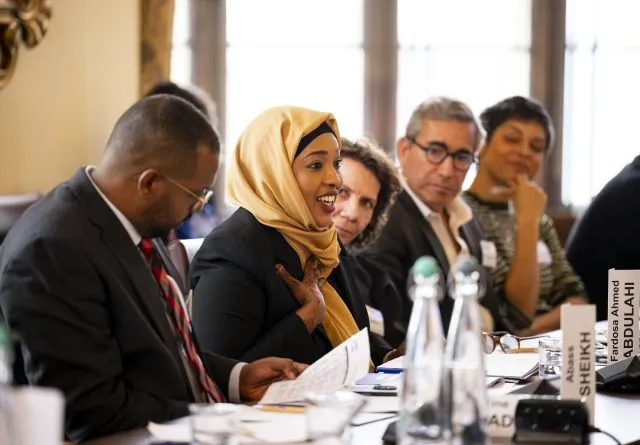
The concluding plenary discussion identified government leadership and coordinated international actors in service of national agendas as key strategies to take forward the recommendations on humanitarian-social protection linkages and financing for social protection in FCAS. Participants identified that donors hold a lot of the power and strongly encouraged them to act to support national social protection plans. There were calls for donors and international actors to be more ‘sheep like’ and show greater willingness to act as a collective in support of government leadership. With some donors prioritising contexts where the most impact is considered possible, countries need to make strong investment cases. Governments need to take greater ownership of directing social protection policy and make the case for donors to coalesce around national systems.
Other actors should be more systematically included in the social protection conversations, including climate finance, peacebuilding actors and civil society actors in crisis affected countries. For Somalia, there were calls for a national dialogue to strengthen engagement with civil society and to build greater support at sub-national levels for investing in social protection systems. In Syria, there was a strong call to stop hesitating and ‘just do it’, to urgently find ways to start supporting national systems. Too much time has already been lost since the fall of Assad and investments urgently need to get started building on and supporting the political will and capacities within the new government.
A critical factor is recalibrating risk appetites by understanding risk in all its (sub) dimensions and developing shared risk assessments and mitigating strategies. Participants recognised the tension between commitments to support government leadership on social protection and donors’ approaches to risk. Participants discussed that where good local systems exist, international support should build on them. However, examples show donors sometimes avoid national systems for political reasons, not technical limitations, while humanitarian actors may still tend to resist government engagement.
Participants were clear that while there are risks in implementation, inaction carries risk too, given that stability following political transition requires moving forward and delivering a peace dividend. Appropriate mitigating strategies can be developed through undertaking more detailed, joint risk assessment and analysis, to identify common concerns, specific and detailed issues, and mitigating strategies. This should be informed by an appreciation that accountability and risk frameworks vary by context: categories of risk are standard but local dynamics differ.
While reiterating that funding through government systems should be prioritised, the discussion highlighted government-led social protection pooled funds as a useful and realistic interim mechanism. Participants noted that pooled funds are sometimes conflated with humanitarian models, whereas this discussion centred on nationally owned approaches. Participants stressed that government must stay central to pooled fund discussions, including how the risks with such funds are perceived and managed.
Participants also linked pooled fund design to transition windows of opportunity, noting that delays in mobilising finance can undermine citizen trust and stability, particularly where governments are new and under pressure to deliver for their population whilst navigating multiple offers of external support. This reinforced the case for developing more transition-ready pooled options, alongside clearer and more accessible information for new governments on what effective, nationally driven pooled funds can look like. While ideal government-led funds require time to establish, early ‘just do it’ experimentation was seen as an important step towards building evidence and trust in these approaches. These funds can also help mitigate the risks of donor funding itself, and agency interests, fragmenting the response.
Next steps: To conclude the event, participants shared their intended actions to take this agenda forward. These included sharing knowledge with teams and wider stakeholders, supporting legal frameworks, advocating for donor risk appetite shifts, engaging with a wider group of donors including the Gulf states, and fostering government-led social protection agendas and platforms. Participants expressed their intent to strengthen understanding of how external support can engage sustainably with local solidarity mechanisms; how to support frontline workers and other local capacities; and how to integrate social protection with peace and climate agendas.
To read the full report including annexes focusing on Syria, Somalia and the global level, download the PDF copy from the link further down the page.
Becky Carter & Carolina Holland-Szyp
Wilton Park | March 2026
In association with

-
Notes
Wilton Park reports are brief summaries of the main points and conclusions of a
conference. The reports reflect rapporteurs’ personal interpretations of the proceedings.
As such they do not constitute any institutional policy of Wilton Park nor do they
necessarily represent the views of the rapporteur. Wilton Park reports and any
recommendations contained therein are for participants and are not a statement of policy
for Wilton Park, the Foreign, Commonwealth and Development Office (FCDO) or His
Majesty’s Government nor any participating governments.
Should you wish to read other Wilton Park reports, or participate in upcoming Wilton Park
events, you can find out more here.
To receive our monthly bulletin and latest updates, please subscribe here.