
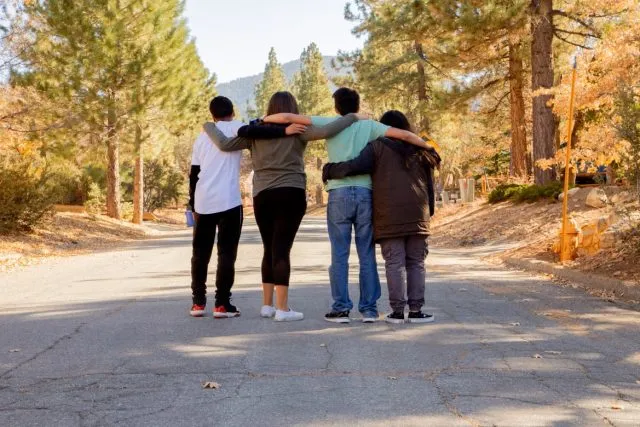
The social and political context for this event is the rise of the “anxious generation” of young people who face social isolation, alienation, and loneliness, amid a political climate of increasing polarisation, tension, conflict, and cultural dissonance. These conditions both damage lives and endanger the fabric of civil society. The overarching practical problem that this Wilton Park event addressed was to examine how society can be repaired, how to include young people and wider society in the repair work, and what structures need to be put in place to achieve this.
At the centre of the solutions that the event worked towards was the essential and central role that empathy must play. Empathy–the “ability to emotionally share another person’s feelings or emotions” and “the ability to understand another person’s emotional state” (Silke et al. 2018)–is understood as a pro-social behaviour that is not innate or fixed, but something that can be developed, nurtured, and promoted. It is, as one participant stated, “a muscle that can be exercised.” It is a means of preventing people from othering those that are different from themselves, a tool for building stronger more resilient communities, and a means of re-embedding liberal democratic norms. It is also a social practice with the power to transform individual lives for the better, not of only young people but also for the benefit of wider society.
Much of the discussion in the event was in relation to problem specification around the agreed need for greater empathy. However, in order for “empathy” to avoid becoming a panchreston, the meeting also focused on solution design. There were two main discourses in the event in relation to policies and the role of the policy community, and in relation to education, especially nonformal education, but also in respect of formal education. A further broad discourse was the role and need for informed research in relation to empathy and how best to integrate that effectively within practical programmes and specific initiatives.
An introduction to empathy
The problem and the context
- Young people are more connected than ever through digital technologies and social media and yet report feeling more isolated than ever.
- Algorithmic social media marketing techniques (seeking “likes” and “shares”) leads in some cases to the creation of content that is designed to inflame and aggravate. In 2025 the Oxford word of the year was “rage bait” – the creation of content that is “deliberately designed to elicit anger or outrage by being frustrating, provocative, or offensive” (Heaton 2025).
- This content is all too often used to promote populist politics (on both left and right) that is rooted in distrust of institutions, polarities of “us and them”, and creates conditions for social isolation and disconnection, described by one participant as a “compassion collapse”.
- Half of the global population are under the age of 25, and face unique challenges, including social isolation, climate change, and increased geo-political upheaval.
Empathy as a solution
- Empathy is not a fixed trait; it is a skill than can be learned.
- Empathy is also shaped by wider values and norms. As such promoting empathy is only half of a solution, the other half rests with the need to address the wider social and cultural context within which empathetic behaviours are nurtured.
- Empathy is a choice “to extend ourselves to others”, but its application is uneven and context is important. Empathy biases exist, whereby people exhibit greater empathy to those who are similar to them, and don’t necessarily empathise with those who appear to be different.
- Empathy is a means for people to be seen, recognised, and listened to by others, and therefore a key means of inclusion in community and, more broadly, civil society.
- Increased empathy leads to better educational outcomes.
Challenges and key issues
- To examine when, where, and why empathy breaks down, or is not present to begin with
- To examine ways to promote or establish empathy not only when doing so is easy, but also, most critically, when it is difficult to do so
- To create policies and systems that cultivate empathy, but to do so without embedding difference