
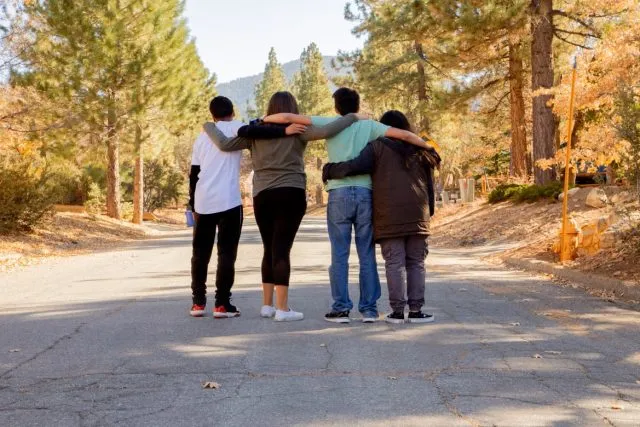
Non-formal education–also referred to as experiential learning, enrichment, and learning-by-doing–encompasses all learning that exists outside of a classroom context. The discussion of non-formal education aimed to examine the ways in which non-formal educational practice could contribute to the development of empathy among young people.
a. Background
- The pedagogical origins of non-formal education were discussed, noting the important of the legacy of the educationalist Kurt Hahn in the formation of various organisations with a commitment to non-formal education and experiential learning, notably Outward Bound, the United World Colleges, and the Duke of Edinburgh’s International Award.
- The discussion noted the commonalities of approach to non-formal educational experiences, based on a shared philosophical background, and models of activity that placed an emphasis on practical service and authentic adventure.
- Education can be a source of social transformation by engendering curiosity and empathy.
- “To move from pity to compassion and empathy, requires curiosity”
- “Curiosity creates connection”
b. Examples
- Sporting activity can be a source of empathy development, for example:
- The development of the Sanctuary Runners and the solidarity found through sport.
- Warriors for Humanity advocates for greater social inclusion for youth through positive environmental projects, linking elite sports players with social projects
-
Case study: Foróige, Ireland. “Turning frustration into action”: how empathetic youth work can transform lives
Foróige is Ireland’s leading youth organisation, rooted in communities and powered by non-formal education. Founded in 1952, it supports young people to organise Foróige clubs where they undertake self-led activities across a range of areas. Clubs provide safe gathering spaces for young people, based on community involvement. Foróige also undertakes youth work programmes, especially to tackle marginalisation. This includes, for example, citizenship development, and programmes targeting crime prevention, and mental health and wellbeing.
Personal testimony: Wilton Park Dialogue, December 2025
“Growing up in a disadvantaged area, I carried a lot: economic stress, limited opportunities, and the kind of low self-esteem that makes you question your worth. In primary school, I struggled with anger. In secondary school I grew quiet-still angry inside, doubting myself, constantly asking “Do I belong”? What changed wasn’t punishment or a label. It was a youth worker asking, “What is going on for you?” and meaning it. That’s where empathy begins: curiosity before connection.
When I joined Leadership for Life[1], facilitators did small powerful things. They listened without rushing. They named strengths I couldn’t see. They gave me permission to try, fail, reflect, and try again. That’s nonformal education at its best: learning by doing, guided by reflection, with choice and voice at the centre. And it builds empathy because you practice seeing from different points of view–your peers, your community and, eventually, that of your own younger self, with kindness.
Our Foróige club tackled antisocial behaviour, mental health, homelessness and the idea that young people were “troublemakers”. We met local politicians and put issues affecting young people on the table. That’s where leadership grows in youth work: young people making decisions, taking responsibility, and turning frustration into agency. And it’s where empathy grows too – listening across differences, taking action together, and learning that your story sits inside a wider community story. People sometimes ask what youth work does that school doesn’t do. Formal education is vital, but it often measures recall and individual attainment. Nonformal education measures growth in confidence, connection, and contribution. It builds the skills that make teams work and communities strong.
What did this mean for me personally? Youth work gave me a sense of self strong enough to face hard days without breaking, and a purpose grounded in service not status. It changed my mental health–giving me a language for triggers and tools for self-regulation. It changed how I communicate–clearer, kinder, more accountable. It changed how I lead–seeing the person, not just the problem, valuing the small consistent moments that accumulate into trust. Empathy isn’t soft; it is transformative. And youth work is its delivery system.”
[1] Leadership for Life is a programme run by Foróige for young people aged 15-18 that develops their leadership skills, with an emphasis on communication, teamwork, problem-solving, critical thinking, and self-awareness. (“Leadership for Life – Foróige” 2025)
-
Case study: Karsa 4 youth project, Indonesia
A Duke of Edinburgh’s International Award Youth Representative set up the Karsa 4 Youth project during the Covid-19 pandemic, a youth-led initiative addressing critical gaps in healthcare access, gender equality, and youth empowerment across Semau Island and Kupang, Indonesia. The island, home to thousands, has only one clinic and limited reproductive health awareness. This creates deeply rooted impacts for young women and vulnerable groups.
Through a Free Mobile Medical Clinic, Sustainable Menstrual Pads Workshops, and Youth Empowerment Workshops, the project improves access to essential healthcare, builds awareness, and cultivates local youth leadership. Beyond providing services, the project encourages young people to discover their potential, become changemakers, and lead future initiatives in their communities – by youth, for youth.
Personal testimony: Wilton Park, December 2025
“Karsa 4 Youth has become more than a platform to serve. It has grown into a place of learning, leadership, and real direct impact that goes far beyond our initial plans.
Young people in our region who were once beneficiaries are now taking the initiative to start their own social projects to improve their communities. What began as a youth-led idea has grown into an organization supported by multiple donors, continuously reaching thousands of people in both rural and urban Indonesia. Proving that youth-led change creates change-makers, not just programs.”
c. Challenges and key issues
- Educational attainment is sometimes framed as the difference between “soft” and “hard” skills. Developing “soft” skills, such as empathy, can be difficult, and requires a re-thinking of educational forms.
- Emphasis on technical skills needs to be supplemented by emphasis on human skills.
- Young people need to be involved in the process of design and implementation
- How can interventions be developed that can reach 3 billion young people globally?
- How can nonformal education be delivered at scale?
- How can interventions reach both the Global South and Global North contexts, and what variations in approach will be required?
- Hard to reach groups and inclusion and exclusion in relation programmes that can foster empathy
- It was noted that “hard to reach groups are hard to reach” and a persistent problem in initiatives designed to boost engagement with civil society is that they become the preserve of middle-class volunteers who are self-selecting
- Young people cannot volunteer for non-formal education when they lack opportunity, resources, and time to do so. Those who cannot, will be left behind
- People who are traumatised or have experienced social isolation or social dislocation are sometimes unwilling to speak or engage with programmes
- Cultural differences can also contribute to exclusion from interventions and programmes, especially where programmes are generic and do not articulate with different cultural modalities