
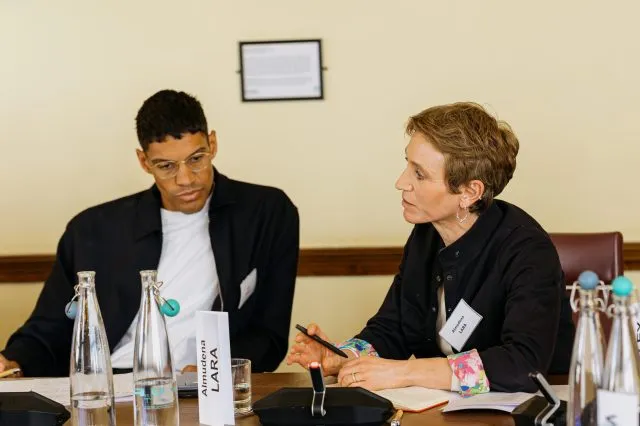
Participants shared experiences of and opinions on how to strengthen the governance, regulation, and oversight of AI technologies, sharing knowledge of gaps and priorities for the future. Some summary points are listed below. The governance and regulation of AI is a complex policy area, particularly when it is unclear how AI will develop and the extent to which a few major companies will dominate versus the proliferation of emergent open-source AI. While there has been a long focus on voluntary commitments and codes on best practice, including transparency and labelling, some participants argued for binding and urgent regulation in the face of competitive commercial dynamics.
Regulators and governments across the world are working hard on approaches to AI, and over 70 countries worldwide have some form of AI regulation in place, with over 1000 regulators globally. But these efforts are fragmented, and it is hard for citizens and companies to navigate. The UK is taking a pragmatic approach, recognising that AI is a general-purpose technology and is applied in different contexts. However, much more work is needed to ensure the protection of children and young people.
Participants discussed responsibilities to keep children safe, and the balance between regulation that penalises unsafe AI use by children and putting the responsibility onto companies to manage products and prevent unsafe use. Clear lines of accountability are needed around individual and platform responsibilities, along with exploring liabilities for harms. Participants raised the dangers of stifling innovation and market competition and of driving companies overseas rather than supporting British industry. New technology is emerging constantly and there needs to be flexibility in the way that regulators can keep companies accountable.
Policy should be seen as a tool to incentivise safety and to create opportunities for British companies in an evolving market. Some participants suggested that regulators and companies should be in constant dialogue as technology evolves, to ensure companies are motivated from a place of optimism and enthusiasm and that they play a role in identifying novel risks that emerge with AI. Lessons could be learnt from the experience of implementing GDPR, which, although it created furore at first, is now widely accepted and sustained.
Some participants argued there indeed could be a ‘race to the top’ by companies with specific interests to ensure AI is beneficial to humanity, and that systemic change happens when market forces align, with regulation inherently part of this. Keeping children safe online does not necessarily preclude monetisation, as companies can benefit from public perceptions of protecting children.
In the fast-paced world of growing AI, there are trade-offs between speed of legislation, parliamentary oversight, and implementation of regulation. For example, the Online Safety Act took four years to pass, and today’s rapid development and proliferation of AI does not allow for long deliberations in Parliament and the public.
Interdisciplinary conversations need to get specific about what concepts of law can support safety for children and young people. A framework and infrastructure for meaningful conversations about regulation of AI could support effective coordination between the UK government, tech experts, regulators, children and young people, parents, and civil society organisations.
Young people said that harms are often due to platform design choices over which they have no influence, but which platform providers can avoid. Many participants argued for safety by design, with a more intentional approach to protecting children from AI harms from the very beginning, throughout the life cycle of the product. Participants raised questions around entry points in the design process of systems, which may be challenging when companies do not want to share information at the design stages. One challenge of embedding safety by design is that AI is always evolving, and harms can emerge unexpectedly and at a later stage; good intent does not always deliver good outcomes.
Social media guardrails tended to emerge after the design was developed. The Online Safety Act has systems and processes at its heart, promoting a practical approach to integrating safety systems and processes into the design cycle, but it focuses on content regulation. Balancing systemic risks around AI safety, privacy, implementation, and practicality is challenging.
Suggestions for actions included:
- Implement binding and urgent regulation on AI.
- Build on existing standards and apply lessons learnt from governance and regulation in other areas.
- Consider a multi-layered approach to regulation that builds in safety from the start and combines general purpose tools to directly reach children and support parental responsibility.
- Hold a child safe AI Summit and other meetings to stimulate global action.
- UK top companies should innovate towards tech safety as part of their leadership and ensure ‘safety-by-design’.
- Tech companies should have a named individual who has responsibility for the safety of children, protecting them against harm and upholding minimum ages.
- Build a plug-in that can be used on all social media platforms that flags harmful content to the Government.
- Create an AI child-friendly kite mark.
- Provide clear world-leading advice for parents.
- Require safety testing of AI products before youth can use them.
- Ensure a central unit in the UK government which supports UK academia and the tech industry with funding for innovation.
- Embed a free and open-source toolkit of AI safety tools in any online platform.