
In partnership with the UK Department for Science, Innovation and Technology (DSIT) and the National Society for the Prevention of Cruelty to Children (NSPCC), and the support of Common Sense Media.
Artificial intelligence (AI) is transforming industries and societies worldwide, offering unprecedented opportunities for innovation and efficiency. However, the rapid development and deployment of AI mean children will be growing up in an age that potentially looks very different from the current one. Harnessing these technologies in the best interests of children and future generations, as well as understanding and addressing risks, requires a coordinated effort. Initiatives to prepare children for the future in an online world are already underway, eg. through the government’s ‘Growing up in the online world: a national consultation’.
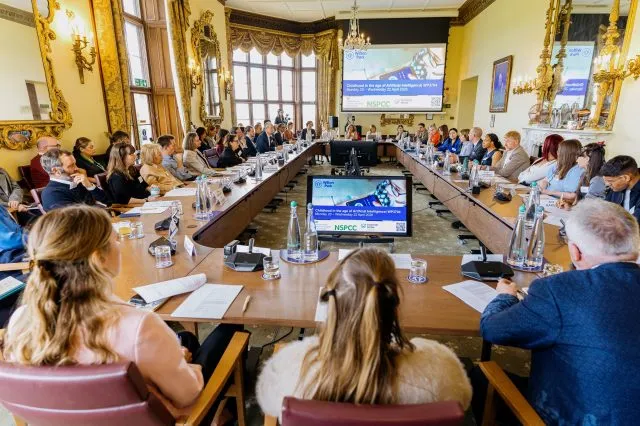
This Wilton Park policy dialogue was a critical step in the journey to ensure children and young people are protected and safe in the future. It brought together representatives from major tech companies, civil society organisations, HM Government, and regulatory authorities, alongside an experienced group of youth advocates to understand what that future could look like, and to bring children’s and young people’s perspectives, often missing in tech design, into the conversation. The policy dialogue was designed to equip participants with the latest knowledge and motivate them to ensure that AI technologies are developed and used responsibly, with a focus on protecting and benefiting children. The dialogue was genuinely inclusive of youth voices – including designing and leading the opening session – and was seen by many participants as one of the best experiences of young people being fully integrated into policy dialogue.
Summary
Key messages from the meeting emerged in the areas of the harms, risks, and opportunities of AI; young people’s trust and participation; and the complexities of governance and regulation of AI. Highlights included:
- AI offers huge opportunities to transform lives, education, work, and to drive economic growth in the UK, but it also carries the potential for enormous harm, especially to children and young people who are increasingly exposed to its ubiquitous presence unsafely.
- As the potential harms of AI are severe, the UK should not sleepwalk into this revolution. Instead of a belated response, the UK has an opportunity to develop responsible AI, with powerful guardrails in place to protect children. Children’s rights and protection must be at the forefront of AI development and deployment.
- The lived experience of children and young people, and findings from research, are crucial to developing AI systems and platforms that are safe and provide a scaffold for human relationships and human development.
- Young people at the meeting expressed a strong sense of responsibility to represent children and young people from across the country, to stop harms from escalating further, and to contribute to a positive vision of the future for their lives.
- Some participants argued for a fast regulatory response for AI in the UK, highlighting the need to channel and harness innovation, and foster the flourishing of AI that benefits society. A young participant remarked that
- “AI is ubiquitous. It is unrealistic to eradicate it. We should be more aggressive in regulating AI for innovation in the UK.”
- Policy should incentivise safety and create opportunities for companies that can play a positive role in identifying and responding to risks of harm against children, building in safety from the start.
- The governance of AI should take a multi-layered, society-wide approach which engages young people meaningfully in decision-making and implementation at all levels.
Suggestions for actions included:
- Ensure diversity among children and young people who participate and advocate in decisions around AI, and include a range of social, economic, and cultural backgrounds as well as broad geographical representation from all four nations.
- Create a new body called Youth TechNet, which connects existing youth advocates across the country from all socio-economic and cultural backgrounds. This streamlines access to youth voice for government and companies, to support decisions on policy and innovation. It should be funded by voluntary members from industry, government, and civil society organisations.
- Create a new UK institute to set global standards for AI that actively support children’s development and ensure collaboration across sectors.
- Build a strategic and multi-layered approach to governance and regulation that targets multiple areas, including safety at the infrastructure level, in searches, on platforms and the device itself. Ensure an ambitious ‘whole of society approach’ and ensure the regulatory system is responsive to change and innovation, including dialogue with tech companies.
- Co-develop a vision and a set of principles for tech companies by which AI can be developed and deployed in ways that protect children and young people from harm and support their development and relationships with others.
- Apply a combination of technology and partnership to protect children from the beginning, and to find and remove harmful material. Do more work to deploy AI classifiers which can block harmful content.
- Communicate clearly what legislation already exists to protect children from AI harms.
- Ensure that the education system at all levels is fit for purpose for the new world of AI.