
In partnership with The Qatar Foundation.
“Participation brings girls into sport, but pathways keep them in it.”
Summary
Despite compelling evidence that participation in sport improves confidence, mobility, leadership capacity, educational outcomes, employability and wellbeing, women and girls still face systemic barriers that limited their ability to engage fully and safely in sporting environments. These challenges are intensified for those from marginalised groups, including women and girls with disabilities, who encountered additional obstacles to access, visibility, and opportunity.
The dialogue co-convened and co-hosted with Qatar Foundation, explored how enabling access to sport for women and girls across the Global South has the opportunity to strengthen social and economic development.
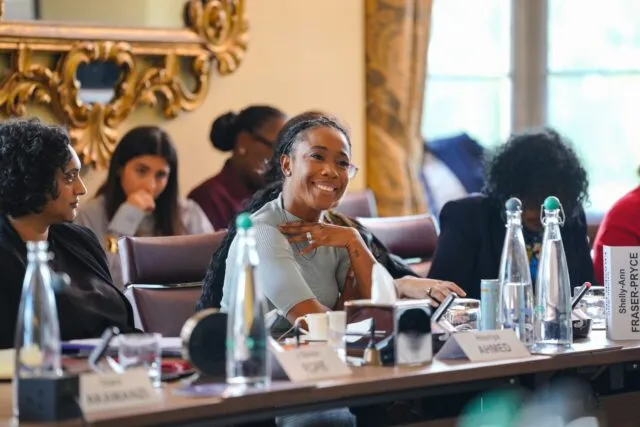
This dialogue brought together policymakers, leading figures from the realm of sports, civil society organisations, non-governmental organisations, multinational development banks, private investment firms, philanthropies, and development experts to identify practical strategies to expand access, address social and structural barriers and create enabling environments for participation and leadership. By doing so, the event explored how inclusive sport contributes to wider development outcomes – from improved learning and health to strengthened human capital and community cohesion.
The dialogue aimed to catalyse collaboration, generate practical insights and shape the global policy agenda on inclusive sport for development.
For sport to fulfil its potential in advancing female empowerment, inclusion and accessibility across the Global South, the following points were advanced during the dialogue:
- access to sport must be safe — safe not in participation alone, but also in the preconditions to maximise potential for wider benefit;
- participation is only a starting point: pathways, not one-off access, are what keep girls and women in sport and allow them to progress into coaching, leadership, policy and other roles;
- representation must move beyond visibility to genuine decision-making power — who makes decisions, holds budgets and sets priorities matters more than who is simply seen; visibility is a starting point;
- structural and governance-level change is needed within sport institutions themselves — including concrete mechanisms, such as additional votes or funding support tied to female representation, rather than relying on visibility or informal change alone;
- local knowledge, local leadership and context-specific design are essential — models cannot simply be transplanted between regions or communities without local considerations;
- traditional and cultural sporting heritage should be treated as an asset in its own right, not overlooked in favour of imported versions;
- educating and equipping the next generation to support the wider sport ecosystem — as coaches, officials, administrators and advocates, not only as athletes — is essential to sustaining progress;
- investment in women and girls in sport must be early, sustained, and tied to long-term outcomes, not measured by medals or single moments of visibility;
- financing needs to diversify beyond grant dependency, drawing in private, philanthropic, diaspora and blended sources, while remaining accountable and evidence-based;
- disability inclusion in sport requires a shift from a charity mindset to a rights-based approach, recognising the inherent value of people with disabilities being present at the table;
- women and girls across the Global South are already leading, often with limited resources or recognition — the task is to recognise, resource and connect that leadership;
- good practice should be shared and adapted rather than continually reinvented – through a genuine “network of networks” and cross-sector coalition — recognising that the scale of this challenge is too large for any single actor;
- the macro impact of sport for development comes from the accumulation of many minor, micro-level actions — individually, and through localised networks.
- There is an opportunity to make small changes that may not seem significant at the time, but can carry a large cumulative impact over a longer, even generational, timeframe; this must be paired with urgency, since much of this work is needed now, even as some of the deeper cultural shifts involved may take a generation, or longer, to fully materialise.
“Sport is a catalyst for the building of confidence, inclusion, social mobility, leadership, and opportunity, and this is particularly true for women and girls in the Global South.”