
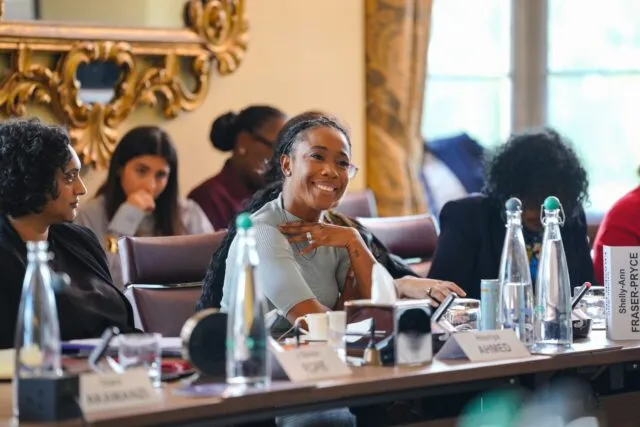
In order to advance female empowerment, inclusion and accessibility through sport, in the course of the dialogue, participants recognised and the following as meaningful next steps. The need to:
- embed safe access as a precondition for any sport for development programming, addressing practical safety needs — coaching, transport, lighting, facilities — alongside broader participation goals;
- build deliberate pathways from participation into coaching, officiating, leadership, policymaking and other roles, so that girls entering sport can see a future for themselves in it beyond playing;
- pursue structural and governance reform within sporting institutions themselves, including targets, transparent appointment processes, and accountability mechanisms, rather than relying on visibility or informal change alone;
- ground programme design in local knowledge and local leadership, resisting the transplantation of models across different regions or contexts without adaptation;
- diversify and sustain financing beyond the grant cycle, through blended, catalytic, diaspora and private investment, underpinned by rigorous, comparable evidence linking sport participation to development outcomes;
- adopt a rights-based approach to disability inclusion in sport, moving away from a charity mindset toward recognising the inherent value and agency of people with disabilities;
- recognise and resource the leadership already exercised by women across the Global South, connecting it to institutions, networks and decision-making structures rather than treating empowerment as something introduced from outside;
- continue building a cross-sector, cross-regional community of practice and coalition, given that the scale of the challenge is too large for any single actor, organisation or country to address alone.
Participants also valued the dialogue itself as a starting point for continued cooperation, using the occasion to begin building partnerships and to stay in contact beyond the meeting.
“We cannot count on luck to be dominant – we need to create pathways.”
Policy Actions from Dialogue (Recommendations)
From the above dialogue the following recommendations were arrived at.
- Develop a global coalition and / or network as a mechanism for sustained dialogue, knowledge exchange, and sharing of best practice.
- Participant and stakeholder wellbeing and safeguarding must be the highest priority in practice not just in principle.
- Source and share good practice in Sport for Development; and its role in achieving broader societal outcomes, grounded in local realities rather than Western/Northern conventions and organisation structures.
- Monitoring and evaluation must be appropriate to the subject matter. Overly burdensome processes and requirements not only weigh heavy on those on the ground but determine the nature of the projects themselves. Funding needs to take this into account sensitively.
- Underpinning adoption and practice of Sports Diplomacy strategy as an enabler for the above. Dedicated strategy facilitates deliberate intentional interventions and support on behalf of relevant stakeholders; and recognises when to support from a distance.
There is so much opportunity for sport to shape the lives of women and girls now and into the future.
J Simon Rofe, Convening Co-Chair, Associate Programme Director, Wilton Park
Houriya Ahmed, Convening Co-Chair, Program Partner, Qatar Foundation
Sylvie Maalouf, Co-Convenor, Program Partner, Qatar Foundation
Maha El-Akoum, Co-Convenor, Program Partner, Qatar Foundation
Louise Gueydon, Rapporteur
Wilton Park | September 2026
-
Notes
Wilton Park reports are brief summaries of the main points and conclusions of a
conference. The reports reflect rapporteurs’ personal interpretations of the proceedings.
As such they do not constitute any institutional policy of Wilton Park nor do they
necessarily represent the views of the rapporteur. Wilton Park reports and any
recommendations contained therein are for participants and are not a statement of policy
for Wilton Park, the Foreign, Commonwealth and Development Office (FCDO) or His
Majesty’s Government nor any participating governments.Should you wish to read other Wilton Park reports, or participate in upcoming Wilton Park
events, you can find out more here.To receive our monthly bulletin and latest updates, please subscribe here.
Qatar Foundation – Unlocking Human Potential
Qatar Foundation, established in 1995, is a non-profit organization focused on education, research and innovation, and community development. Its ecosystem comprises more than 50 entities dedicated to progressive education, sustainability, Artificial Intelligence, precision health, and social progress. For a complete list of QF’s initiatives and projects, please visit: www.qf.org.qa