
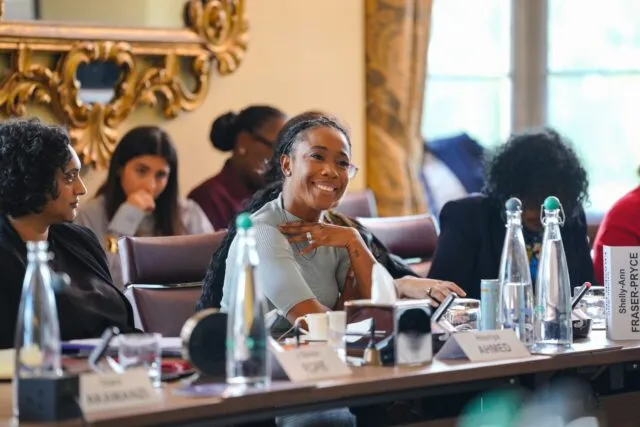
Women may be increasingly visible in sport, but visibility is not the same as agency or power. Real decisions are often made by those who have influence over institutions, money, rules, media rights and sponsorships — spaces too often beyond the reach of women in sport.
- Good practice: Kenya — simply changing the number of women on the field was not enough; the structure of governance itself needed to change. A target was set for women’s representation across sport and its institutions, with transparent appointment processes, including elections managed by an independent electoral commission to ensure fair play. Sustainability was supported by a mentorship policy built on structures that already existed, and leadership camps for young female athletes brought in role models — including from outside the sport world — to speak on self-esteem and financial literacy, partly in response to cases of women athletes being harmed by their partners.
While attention rightly focuses on the Global South in this discussion, participants noted that underrepresentation of women in decision-making is an issue that cuts across regions — progress is more likely when all regions work together, since sport is a global common good. On why excellence on the field rarely translates into leadership off it: it was noted that women athletes are not automatically trusted to lead.
In many sport environments, female athletes, particularly women of different race, religion or cultural background, may still find themselves as the “only ones who look like them”. How do we go from the kid who see themselves represented, the one who was told she was not good enough, to winning an Olympic Medal?
Representation needs to move beyond participation: women need to be represented as leaders at federation level, as investors and as policymakers, so that a girl can see herself as a coach or decision-maker, not only as an athlete. This requires intentional pathways — access to networks, mentorship and traineeships — since athletes already develop many of the qualities aligned with leadership, but a clear bridge rarely exists.
“Participation brings girls into sport, but pathways keep them in it.”
Barriers exist within sport culture itself, not only in wider society — in the gaps between visibility and influence, and between authority on and off the field. This impacts athletes, journalists, referees, coaches and officials alike. Programme design varies in response: some give no consideration to gender at all, others apply a gender-neutral approach that treats everyone the same, and fewer take a genuinely gender-responsive approach that adapts to need — raising the question of what a gender-transformative approach, capable of challenging the system itself, would look like. Responsibility for that transformation sits across governments, funders, commercial partners and broadcasters as much as sport institutions, requiring shared vision and meaningful consultation with those affected.
This matters particularly for the Global South, where discussion often focuses on barriers rather than the leadership women already exercise there, frequently with little recognition or resource. The future of women’s sport should be designed and led by communities, not designed for them. This momentum is not only about transforming sport for women and girls, but for everyone — evidence elsewhere shows that when women hold positions of power, many systemic issues that also harm boys and men are addressed.
- Good practice: World Rowing has achieved close to equal representation of men and women on the executive committee, councils and commission chairs — not through quotas, but by recognising and empowering women already prepared for these roles. The sport has had 29 consecutive years of female presidency. Structural mechanisms include additional support for federations that bring more than one woman to Congress, and an additional vote granted to active members who, over a four-year cycle, ensure at least 25 per cent of the crews they send are of the opposite gender.
- Good practice: Inclusion was front and centre during the FIFA World Cup 2022 games in Qatar. Stadiums and fan zones were equipped with sensory rooms, wheelchair accessible pathways and families with special needs received targeted services through specialized access passes. Women were visible from the management of the event to the news anchors, photographers, and volunteers, challenging stereotypes of Arab women in sport.
This session highlighted two important points: first, the need for rigorous enforcement of equity practices, and secondly, the role sport plays in embodying hope and possibility. The challenge raised was how a “network of networks” could be built to enhance that opportunity.
Participants further discussed women’s sport as a form of diplomacy, considering what comes after a breakthrough moment – whether there is a strategy for long-term sustainability, and what genuine follow-through looks like over time, rather than treating a moment of visibility as an endpoint. This included questioning whether partners are engaging in a genuine two-way relationship with local communities and grassroots organisations or are primarily interested in broadcasting a moment.
In considering genuine investment from gender-washing or sponsorship dressed as partnership: participants discussed the alignment of values, and the importance of looking at whether frameworks and policies are actually implemented, rather than existing only as a standalone policy for show. A double standard was also noted in what is expected of women’s sport diplomacy compared with its male counterpart.
For Global South female athletes, diplomacy should prioritise safety and wellbeing. Noting here that infrastructure and cultures are critical to enforcing safeguarding — both physical and social. Since visibility is not always possible for some athletes, given safety concerns or country context, the idea of ambassadors representing those who cannot be visible themselves was raised, alongside mentorship, education, and breaking generational cycles. What should not be on that agenda: a monolithic identity imposed on Global South athletes or communities, and one-off payments treated as meaningful engagement. Questions were also raised about who holds decision-making power, and what state a community or partnership is left in once external partners leave.
- Good practice: The Basketball Without Borders programme focuses on making talent identification more systematic, rather than leaving it to chance or ‘mistakes’, and therefore allows for more support throughout the process for those who do not achieve elite player status.
- Good practice: BAL Basketball Africa League is run explicitly as a business over a charity, operates in partnership with pan-continental governments since its launch in 2019 while building a pathway from grassroots to elite level.
- Investing in infrastructure was described as necessary to scale, and investing in people as an investment in leadership and skills for young people: citing that 94% of women CEOs played sport growing up.
Structural inequality between genders remains a constraint; for sport to drive positive change, the systems and governance around it need to change too.
- Good practice: Wahine Toa — a Māori programme for women in coaching and administration within governance structures, with five reports produced to date. Recognised by the New Zealand government and New Zealand Olympic Committee, gifting places for 50 people to attend a week-long programme, with potential to be adapted to other regions through collaboration.
“The system should carry talent forward, rather than waiting for exceptional individuals to carry the system.”