
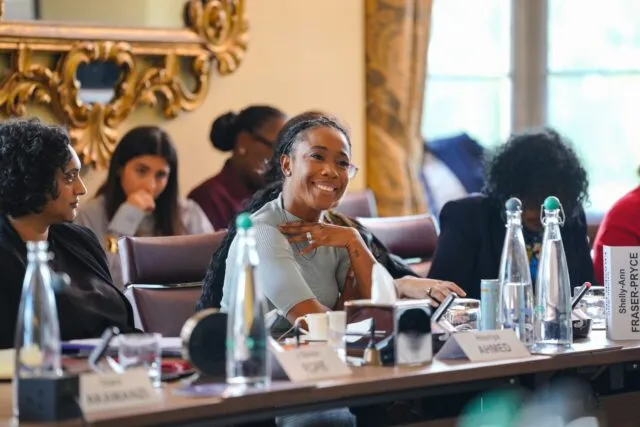
Participants reflected on the power of working across different sectors, and on the real possibility of shifting the wider conversation from giving to investing — noting that this shift will require a strong academic and evidence base. There is an opportunity for this cross-sector community of practice to build a shared evidence base, and to keep learning collectively about what to measure, and why.
On building coalition: participants discussed how to use the collective power of those in the room, while leaving space for those who want to be part of change but are not present — citing Togo as an example, where the country’s leadership was invited to ask what more could be done. Ways to help included scaling and sharing resources, advocating together, and creating a platform to learn from and replicate success stories from across the sector.
On Global South/Global North financing dynamics: most current investment still originates in the Global North. Opportunities raised included the potential of disruptive technology and high mobile phone penetration in Global South nations to enable new models of financial sustainability; the significant, often underexamined, online audiences and monetisation around lesser-known sports; and the potential to activate mature diaspora communities in financing sport differently.
Moving the needle requires shifting perceptions from “giving” to sport for development to “investment” in sport for development – a sustained investment in the systems, structures and pathways for women and girls early, before the Olympic Medals are won.
Despite significant progress, gains remain fragile and more work is needed — including helping the current generation of young athletes connect with one another globally to build networks for the future.
Closing reflections centred on two points: 1. the macro impact of many minor, micro-level actions — individually, and through personal networks, small changes can carry significant cumulative impact over a generational timeframe, and 2. paired with urgency, since much of this work is needed now, even as some of the deeper cultural shifts involved may take a generation, or longer, to fully materialise.
Final reflections stressed the importance of committing to a course of action and building a community of practice spanning grassroots and leadership levels, recognising the scale of the challenge is too large for any single actor.
- Good practice: A Qatar Foundation, and Basketball Africa League collaboration, facilitated by Qatar Sports Investment, will see two newly refurbished basketball courts working with local communities in Senegal and Nigeria for 2026, with two more courts opened in 2027 and 2028. It is one of a number of ongoing projects, which can be replicated and scaled.
“It only takes one voice to open the door.”