
In partnership with The British Embassy to the Holy See, Foreign, Commonwealth and Development Office, Project Dandelion, The Women, Faith, and Climate Network and Islamic Relief Worldwide
Summary
-
“Across the world, women in faith communities are already leading extraordinary initiatives that empower women, strengthen resilience, and improve livelihoods in communities already experiencing the impacts of climate change. What if the thousands of grassroots leaders already working in different faith traditions began to collaborate across religious boundaries? What new momentum could be unleashed if these initiatives shared knowledge, visibility, and support?”
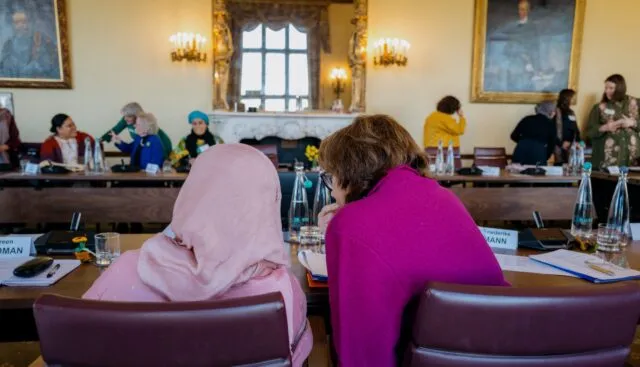
This meeting convened leaders of women of faith networks and their male allies, climate action practitioners, policymakers and strategists to explore how radical collaboration can accelerate climate and nature action through faith-based networks, with a particular focus on women’s leadership.
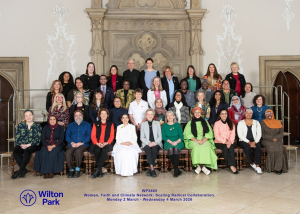
To explore these opportunities the meeting brought together over 40 participants from 17 different countries and from 8 different faith traditions.
It was the first formal meeting of the Women, Faith, and Climate Network (WFCN). WFCN is global network of women of faith and spirituality networks whose millions of members are working for healthy, sustainable environments in their local communities. Its mission is to go further, faster to reach climate goals by supporting and scaling up women of faith and values-led climate action in their local communities. It aims to do this by:
- Increasing the visibility of women of faith-led climate action though mapping, storytelling, and communications
- Scaling up impact on climate goals by supporting member connection, learning exchange, partnerships and practical collaborations on specific areas of faith-based climate action including renewable energy, sustainable agriculture, environmental focal points (eco champs) and others
- Combining forces for joint women of faith- led advocacy at key climate related events including COPs, UNEA, CSW, African Union, and national events such as London Climate Week
- Amplifying climate action and advocacy by bridging and connecting faith and secular initiatives
- Supporting multi-faith collaboration for a sustainable world among women of faith networks at the local community level
- Establishing, funding and staffing a coordinating mechanism for the Network to support connection, exchange and collaboration among members at global and local levels
The discussions at Wilton Park took place against a backdrop of increasing global instability, marked by conflict in multiple regions, deepening inequality, anxiety, and accelerating climate impacts. Participants recognised that these crises are interconnected and must be understood as part of a wider systemic and moral challenge.
A central conclusion of the meeting was that incremental approaches and fragmented efforts are no longer adequate to address the scale and urgency of the climate and nature crisis. Instead, participants emphasised the need for a more ambitious and coordinated approach grounded in radical collaboration. This requires moving beyond traditional models of partnership towards deeper forms of alignment in strategy, resources, and action at the institutional level and on a personal, individual level.
The discussions highlighted three interrelated commitments:
- First, there is a need to cultivate shared moral clarity, rooted in a shared sense of broken heartedness and a willingness to confront the realities of climate breakdown.
- Second, participants emphasised the importance of collective healing and the transformation of harmful systems, alongside a willingness to imagine what alternative models grounded in justice and care look like.
- Third, there was a strong call for courageous and trust-based collaboration, involving the sharing of power, platforms and resources.
-
“In a world often shaped by division, these women came together not to argue over differences but to ask how faith could become a force for healing both for our wounded planet and for our fractured human family.”
The meeting affirmed the powerful and underappreciated role of women’s leadership and in particular the influential role played by women of faith and their vast networks, as agents of change for environmental sustainability in their local communities around the world.
The Women, Faith, and Climate Network (WFCN) was widely seen as uniquely positioned. It is characterised as a network that is not exclusive to women but women-led. Its strengths lie in its ability to scale up ongoing local community based environmental action, to connect grassroots action with global influence, to bridge faith traditions and sectors, and to enable coordinated leadership that is both values-driven and action-oriented in the current extent of the work that faith-based organisations, institutions, and networks are already engaged in globally.
-
“We stepped into this new female ‘laboratory of radical collaboration’.”
Key outcomes of the meeting:
- Community building—friendship, common cause and collaboration across faiths and geographies was reinforced, with important new connections, partnerships and collaborations seeded in the room
- Learning exchange—strong examples were shared in three areas of women-led collaborative local climate action: Eco Champs, Sustainable Agriculture and Renewable Energy; calls and commitments to ongoing exchange and to establish communities of practice
- Affirmation of WFCN as a valuable platform for fostering “radical kindship” and for scaling up “radical collaboration”; calls for regional and local WFCN Hubs;
- Agreement on common values, ways of working, and recommendations for priorities going forward; calls for Working Groups on: WFCN guiding values; Theological and spiritual grounding for the work; Theory of Change.
- Commitments to action: participants generously committed to specific actions to advance women-led environmental sustainability, and to tangible support for WFCN, including commitments of time, financial and technical resources, leadership and other in-kind support
- Direction for the way forward: affirmation of plan to establish WFCN as charitable entity with strong regional governance structure; priority of fundraising and setting up a working group to support