
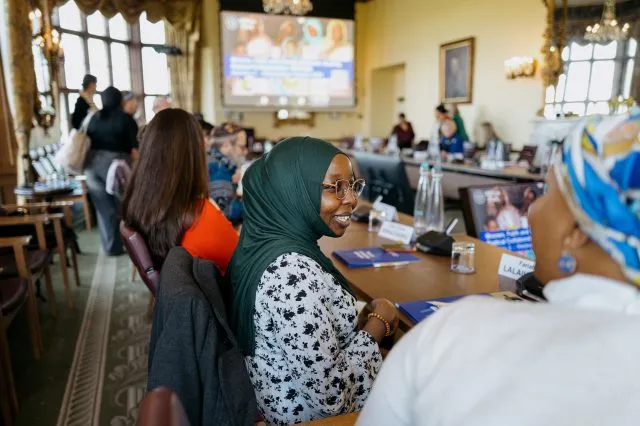
Another session built on a July 2025 on-line WFCN workshop on sustainable agriculture. Hosted by Global One, UISG and the Organization for African Instituted Churches this was a learning exchange on sustainable agriculture among women of faith networks. It brought together women of faith to share local knowledge, good practices and grassroots efforts to address environmental challenges through sustainable, community-based agriculture. It was followed in October 2025 by an in-person local learning exchange among women of faith networks organized by WFCN members, the Organization of African Instituted Churches, Uzury Empowerment, Catholic Sisters, GreenFaith and others in Nairobi. Further details on the Sustainable Agriculture Sharing Fair are here.
Examples of various approaches to faith-inspired sustainable agriculture were offered by representatives from the Organization of African Instituted Churches, GreenFaith, Global One, and the Union of International Superiors General. The discussion drew on existing tools that integrate faith principles with sustainable agricultural practices such as the Islamic Farming Toolkit. This resource demonstrates how religious teachings can be translated into practical guidance, enabling communities to adopt more sustainable methods while remaining rooted in their traditions. As in the example of Esther, attention was drawn to the importance of action being bedded in the traditions and stories of each faith tradition. Islamic Farming and training Muslim women’s groups in organic farming drew from historical examples of women in Islam, framing them as agents of ethical change. Increasing the visibility of women farmers and giving them a seat at policy tables, was underlined as key to affirming their dignity and power.
Links to other faith-inspired resources including Brahma Kumaris Yogic Farming, AROCHA Farming God’s Way , Eko Sikh Guru Nanak Sacred Forest can be found here , and information about World Vision’s Farmer-managed Natural Regeneration, here.
In the context of 2026 having been designated by the UN as the International Year of the Woman Farmer, discussion focussed on how faith-based networks can build on existing initiatives to create integrated, large-scale programmes. Participants examined how the best practices shared might be replicated and how radical collaboration might support the scaling of women-led sustainable agriculture.
Participants concluded that sustainable agriculture is an entry point to building resilient communities and that it is essential to bridge between indigenous knowledge and modern methods. WFCN Member networks gave examples of building the capacity of women farmers by connecting them to each other, equipping them with models, mentorship, tools and resources, including small grants. Women of faith are often well equipped to lead in this area through their community connections and the trust accorded to them. It was also noted that women-led efforts are often under-resourced and operate in isolation.
Scaling such approaches requires coordinated action. Participants highlighted the need for partnerships that span the entire agricultural value chain, from production and processing to distribution and finance. This includes collaboration with technical experts, financial institutions and policymakers.
There was also recognition that scaling must remain responsive to local contexts, including faiths. Rather than imposing uniform solutions, the goal should be to create adaptable frameworks that can be implemented in diverse settings. Toolkits, for example, can be tailored to specific faiths and geographies. A Community of Practice in Sustainable Agriculture as a platform for mutual support and ongoing learning exchange was proposed.