
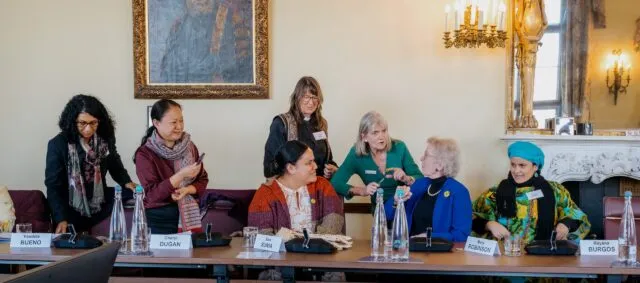
The final session was on renewable energy. The July 2025 on-line WFCN workshop had focused on SE Asia and was hosted by Brahma Kumaris, Ora Development Advisors and the Self Employed Women’s Association (SEWA). It showcased successful models of women-led renewable energy initiatives from South Asia and Africa, explored practical strategies for climate justice and identified key steps to scale up faith-led, women centred renewable energy solutions.
Brahma Kumaris and SEWA followed the initial Workshop with an exchange of site visits to explore shared core values, complementary strengths and technologies, and possible areas of partnership and collaboration
The potential for scaling up through collaboration is significant. SEWA has over 3.8 million members, making it the single largest union of informal sector women workers and Brahma Kumaris counts over a million students in its numbers. Their proposed partnership combines SEWA’s track record of women’s empowerment, its extensive network of women farmers, its Swacch Aakash (Cleaner Skies) Campaign, and methodology for developing self-sufficiency and green solutions, with the Brahma Kumaris’ expertise in renewable energy, yogic farming and spiritual education.
SEWA and Brahma Kumaris identified shared core values:
- Inner Empowerment – Women’s self-respect, dignity and leadership
- Care for the Earth
- Community unity and collective responsibility
- Inclusive, ethical, and sustainable development
- Faith-informed, women-led, climate-resilient rural transformation
SEWA and Brahma Kumaris presented two joint pilot projects currently under development.
- the Kamla Induction Cooking pilot project for the development of two solar-powered community kitchens, building on SEWA’s “Kamla” cafes, with technical support on induction cooking from Brahma Kumaris. Use of solar power for cooking would radically cut carbon emissions and costs
- A Self-Sufficient Village and Sustainable Future through Women-Led Solarisation of Households and Livelihoods pilot project. This builds on Brahma Kumaris’ Raj Rishi Gokul Gram Wholistic Village Development and draws on SEWA’s Hariyali Gaam Green Village Initiative and its extensive experience with women’s empowerment
These projects were put forward as powerful examples of what radical collaboration can achieve in practice, building on shared core values, and complementary strengths and methodologies, and demonstrating how renewable energy can be integrated into broader community development initiatives. The potential for scaling from the proposed pilot projects is enormous. The presenters called on participants to assist with the funding requirements to launch the pilot programmes. Participants also pointed to the potential for collaboration with technical organisations and private sector actors, particularly in areas such as training and financing.
Other projects here were shared such as the Elle Solaire Mobile Academy in Senegal which offers an example of valuing indigenous farming methods and linking to new technologies. The Academy trains illiterate women to use smart phone and solar technology. It uses a women-led experiential learning method to increase livelihoods, establishing village savings and loan associations and even solar powered hair salons!
A key conclusion was that technology alone is insufficient to bring about real change. Successful energy transitions also require community engagement, capacity building and cultural alignment. Faith-based organisations are uniquely positioned to address these dimensions, bridging the gap between innovation and implementation.
Participants emphasised the importance of learning from existing initiatives and building on proven models. This includes documenting best practices, facilitating peer exchange and developing joint funding proposals. By working together, WFCN members can accelerate the adoption of renewable energy solutions and ensure that they are accessible to the most vulnerable communities.