
-
“When women of faith lead, entire communities move”
This meeting took place at a moment of acute global tension. Participants gathered in the immediate aftermath of escalating conflict in various regions globally, following intensified hostilities and in particular, days after the start of war in Iran. This impacted the travel arrangements and attendance of some participants. The sense of fragility and uncertainty was palpable. Yet rather than diminishing the urgency of climate action, this context sharpened it. Participants reflected on the moral obligations of courageous leadership, and on the challenge of holding multiple crises at once, recognising that climate change, conflict, inequality and displacement are deeply interconnected.
At the same time, the meeting coincided with a rare convergence of sacred seasons in the religious calendar, with the Holy month of Ramadan, the Christian season of Lent, the Jewish festival of Purim, and the Hindu celebration of Holi overlapping. These festivals and seasons of transformation, created a powerful shared space to pause, reflect and to return to what truly matters. In sharing meals, prayer, songs, reflections, and symbols of courage, participants spoke of their traditions as a lived expression of solidarity across a global humanity, or “radical kinship”, a reminder that faith communities are not only responding to crisis, but also embodying hope and values for people and the planet.
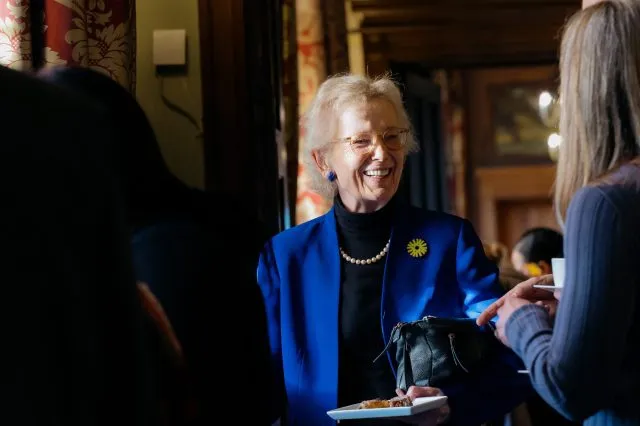
Ruth Davis, the UK Government’s first representative for Nature, opened the gathering by a reminder that women of faith bring something the world urgently needs right now: moral authority. Authority grounded not in hierarchy, but in service, credibility and lived experience through communities of trust. She spoke of her hope that the dialogue would generate practical ideas – and committed to ensure that those ideas would feed into how the UK government thinks about nature and the future. She encouraged and promised support for the leadership of women of faith as agents of change for care for creation.
The opening reflections from the co-founder of Project Dandelion and former President of Ireland, Mary Robinson framed an urgent and deeply challenging call to action:
-
“We must allow ourselves to practice broken-heartedness – together.
I am not talking about despair, rather about the need for moral clarity.
A broken heart is not a weak heart. It is an open heart. If we insulate ourselves from the grief of what is happening in our world — the loss of species, the displacement of communities, the anxiety of young people — we risk becoming indifferent. Our compassion cannot be selective. The suffering caused by climate breakdown demands of us the same moral seriousness as the suffering caused by war. These must not be seen as competing claims on our conscience.
We are living in a time when our hearts are asked to stretch beyond what is bearable and hold multiple crisis in our heart. The climate and nature crisis doesn’t pause because of war. We are reminded that all crises can be a turning point, that darkness is not the end of things. Our collaboration provides hope in what seems a hopeless world.”
This call to practice broken heartedness together is a reminder that we cannot insulate ourselves from suffering, nor pretend that war and climate compete for space in our consciences. It demands a deeper, more integrated response.
Mary Robinson called for three commitments for this movement: to stay open hearted rather than turning away; to practice healing together by naming harm and modelling what is possible; and to work together with a depth of solidarity that matches the scale of the challenge.
The festival of Purim fell on the first evening of the meeting, providing an example of how faith traditions can draw from their sources and their stories to inspire the courage and risk taking needed to meet current challenges came from the story of Esther celebrated in the Jewish festival of Purim which commemorates the saving of the Jewish people in the ancient Persian Empire. Participants heard how the courage of Queen Esther prevented violence and saved her people. In the Jewish tradition, Esther is remembered not as a warrior but as a woman whose moral clarity and resolve changed the course of events. Her story became a powerful symbol for the gathering: a reminder that women’s leadership can avert destruction and open pathways to peace. And like her, it was said, women have no choice but to act. As Mordecai pointed out to Queen Esther “And who knows whether you have not attained royalty for such a time as this”. The lesson for the participants gathered was that it is no coincidence that we are in our positions now, that we cannot remain silent, we are destined and called for critical interventions.
Reference was also made to how the meeting builds on a renewed sense of hope, pointing to the recent Laudato Si Raising Hope conference and to the Global Ethical Stocktakes that had taken place worldwide in preparation for COP30 held in Brazil in 2025.
This framing resonated throughout the meeting, anchoring discussions in both urgency and compassion.
The central question underpinning the gathering was clear: how can women of faith, working through networks of trust and shared values, mobilise at scale to respond to the climate crisis? The answer, participants suggested, lies in moving beyond incremental approaches towards radical collaboration, stepping forward, often from positions of marginalisation, to shape a model of partnership that is deeper, more ambitious and more aligned with the scale of the challenge in this time of existential crisis.
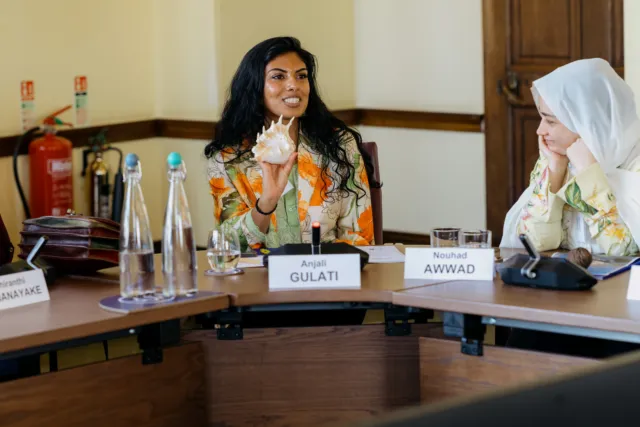
Participants brought many significant objects to the table to symbolise their motivation to care for our common home –a dried red rose as symbol of love , beans for food sovereignty, daffodils and cherry blossom for joy, an olive branch for interfaith action, lichen for the power of quiet elements, red beads signifying work to be done, a sliver of gneiss rock for how heat and pressure make us stronger, and coral fossil as reminder of the vast continuum of time.