
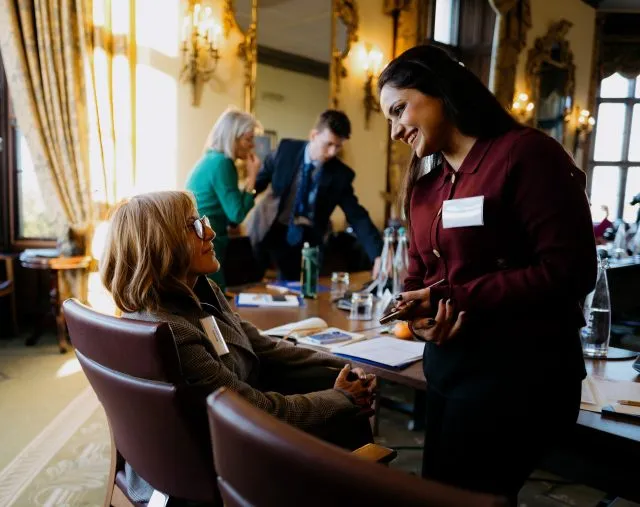
This meeting offered a compelling vision of both the urgency of the climate crisis and the potential of faith-based networks to respond at scale. Women of faith and women of faith networks, working through trusted community structures, are already driving significant change. With the right support and coordination, their impact can be multiplied.
Members worked in small groups to develop recommendations for the way forward for WFCN. Recommendations covered sustainable organisational structure, resourcing and funding, strengthening the relational connectivity of the Network, support for radical collaboration, and amplifying the visibility and collective voice of women of faith in climate work.
At the conclusion of the meeting all participants made individual concrete commitments to take the work of WFCN forward. These very generous commitments include gifts of time, financial resources, sharing knowledge and training resources, co-leading WFCN Hubs and working groups, participation in WFCN governance structures, research, hosting meetings, and last but not least, prayer and spiritual support for the WFCN and its members.
Participants identified several priorities for the next phase. These include developing joint proposals, strengthening partnerships and creating mechanisms for ongoing collaboration. There was also a strong emphasis on advocacy, particularly in relation to global processes such as climate negotiations.
The Network needs to be a shared space for sacred activism, motivated by different values of love and hope and gratitude.
The Network has a critical role to play in this process. By connecting actors, aligning efforts and amplifying voices, it can help to translate hope into action. This requires clarity of purpose, effective communication and sustained investment in relationships.
On a deeper level, the meeting reinforced a sense that transformative change in possible. Participants, it was said, are not“mourners at a deathbed of the earth, but midwives at the birth of a new creation” framing the Network’s role as urgent and critical for the renewal of the Religion and Ecology Movement.
Radical collaboration offers a pathway to achieving this scale. It challenges organisations to move beyond traditional models of partnership and to embrace a more integrated and ambitious approach. While this requires effort and commitment, the potential benefits are substantial.
The Women, Faith, and Climate Network provides a unique platform for this work. By fostering relationships, enabling collaboration and amplifying action, it can help to build a movement that is both locally rooted and globally connected.
At a time of uncertainty and crisis, the meeting offered a clear message of hope. Through shared values, collective action and a commitment to collaboration, transformative change is within reach. The task now is to realise this potential and to ensure that the energy and insights generated during these discussions are translated into sustained and meaningful impact.
Mary Robinson completed her remarks with a call to participants to be “light bringers”, building on words often attributed to Francis of Assisi:
“Such love
does the sky now pour
that whenever I stand in a field,
I have to wring out the light,
when I get home.”
-
“—– let us stand in the field attentive to both grief and grace so we allow our hearts to be opened, not hardened. But let this also be a pivotal moment that will allow us to return from here, into our communities and our institutions ready to wring out the light! We need as much light as possible in these dark times. Women of faith, and our good male allies, we must be those light bringers!”
The report was prepared with assistance from Azmaira Alibhai, and with the additional input of the partners
Wilton Park | April 2026
In partnership with

-
Notes
Wilton Park reports are brief summaries of the main points and conclusions of a
conference. The reports reflect rapporteurs’ personal interpretations of the proceedings.
As such they do not constitute any institutional policy of Wilton Park nor do they
necessarily represent the views of the rapporteur. Wilton Park reports and any
recommendations contained therein are for participants and are not a statement of policy
for Wilton Park, the Foreign, Commonwealth and Development Office (FCDO) or His
Majesty’s Government nor any participating governments.
Should you wish to read other Wilton Park reports, or participate in upcoming Wilton Park
events, you can find out more here.
To receive our monthly bulletin and latest updates, please subscribe here.