
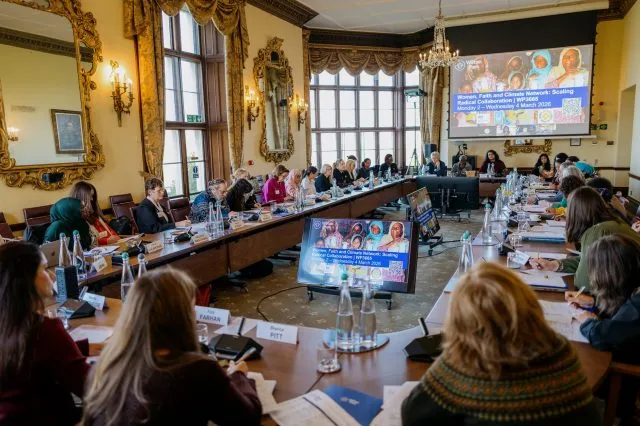
The opening sessions of the meeting built on the regional online Women, Faith and Climate Network Collaboration Workshop Series held in 2025.
The first of these workshops was on the topic of “Eco Champs”. Eco Champs are Environmental Focal Points (EFP), individuals selected, trained and supported to serve as leaders in their networks to promote and scale up sustainable environments. The June 2025 Workshop was hosted by the Mothers’ Union, the Anglican Church of Southern Africa and the Church of England. Their presentations described how Eco Champs are recruited, trained and positioned as resources for church structures, laywomen’s groups and environmental ministries to generate sustainable, locally grounded environmental impact on a large scale.
Many WFCN members have Eco-Champ-style programmes in place. Subsequent to the June 2025 Workshop WFCN convened 2 information exchange and exploratory meetings including 14 women of faith member networks. A Report was prepared summarizing WFCN member EFP programmes, with numbers estimated at 23,983 Eco-Champ leaders.
The Eco Champs session at the Dialogue built on this work to present various models of Eco Champs, along with recommendations about how their impact could be scaled up though learning exchange, adaptation of training materials, networking among Eco Champs at the local level, and through radical collaboration.
Presentations demonstrated that the foundations for large-scale mobilisation already exist within faith communities, particularly through women’s groups, and that trained Eco Champs can have a multiplier effect
One prominent example came from the Mothers’ Union, focusing on their “Eco-Champions/Eco-Champs” programme across 24 dioceses in Southern Africa. These champions, primarily women, are embedded within their communities and lead initiatives ranging from waste and water reduction and reforestation to climate education. Their effectiveness lies not only in their activities, but in their ability to connect environmental action with faith-based values and daily life.
-
“Eco Champions can be found in every community. We just need to name them, train them, and support them.”
One important way to scale up faith-inspired climate action from the local community level is to have it recognised and inserted into the formal structure and strategy of the religious institution. For example, a new strategy for environmental action has been formalised as a mandate for the Mothers’ Union. This new strategy recommends the expansion of environmental work including recruiting new partners, intergenerational engagement and promoting buy-in at places of worship and education.
Similarly, the work of the Buddhist Tzu Chi Foundation illustrated the scale that can be achieved through sustained community engagement. With millions of women volunteers, the Foundation has integrated environmental stewardship into its humanitarian programmes, promoting its simple living and vegetarian lifestyles and demonstrating how faith-based mobilisation can reach a vast number of people. Tzu Chi expressed readiness to partner with the Mothers’ Union in 7 countries.
Participants also reflected on the Laudato Si’ Movement’s programme and training of over 20,000 Laudato Si’ Animators in 52 countries. These Animators act as catalysts within their communities, translating global climate commitments into local action. Laudato Si’ offered to share training materials and other resources to support scaling up of Eco Champs programmes by other WFCN members
Mention was made of parallel initiatives across other traditions include the “Green Angels” of the Brahma Kumaris World Spiritual University, “Cooperation Circles” of the United Religions Initiative, “Eco-Churches” of the Church of England, the “Green Apostles” of the United Reform Church, “Green Dharmas” in the Buddhist tradition and the Salvation Army’s Environmental Champions in the UK.
Across these examples, several common elements emerged. First, leadership is decentralised and rooted in community relationships. Second, action is framed in moral and spiritual terms, making it both meaningful and motivating. Third, existing institutional structures provide a platform for training and scale.
The discussion then turned to how such models can be expanded. Participants emphasised the importance of shared training resources, peer learning and mentorship. Connecting Eco Champs to each other in local areas could reinforce collaboration, and to support this, a proposal for mapping Eco Champs was made. There was also strong support for creating pathways that enable grassroots leaders to connect with national and global platforms, ensuring that their voices inform broader strategies.
In this context, the Women, Faith, and Climate Network was seen as playing a critical role in linking these local initiatives into a wider movement. By connecting “Eco-Champs” across regions and traditions, and facilitating learning exchange and collaboration the Network can amplify their impact.