
-
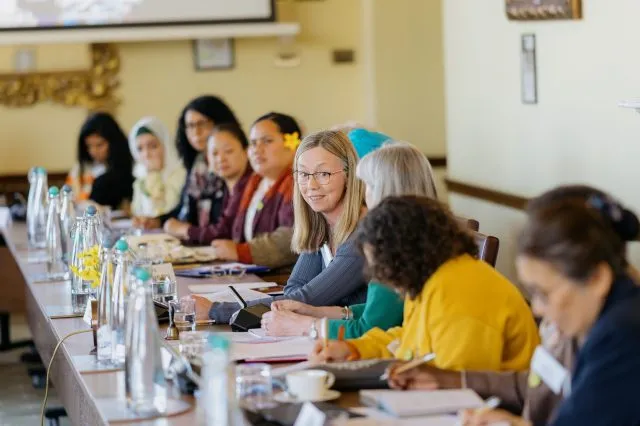
“The forces driving radical destruction are radically aligned. We are now living in a moment that requires us to radically collaborate to show a different way of living, to undermine the narrative that religion divides and to show that everything is interconnected. This needs interconnected leadership and a move from a mindset of scarcity to a mindset of abundance. This Network is that laboratory of radical collaboration”
Early discussions explored why radical collaboration is not only desirable but necessary. While faith-based organisations have long been active in climate and environmental work, intersecting with humanitarian relief efforts, their efforts remain fragmented. In contrast, the systems driving environmental degradation operate with high levels of coordination, shared strategy and sustained investment.
Participants reflected that without a comparable level of alignment, faith-based action will struggle to achieve systemic impact. Radical collaboration was therefore understood not as an aspiration, but as a strategic imperative. As a participant noted, “what if the thousands of grassroots leaders already working in different faith traditions began to collaborate across religions?”
Such collaboration must move beyond symbolic, “polite” partnership to something more demanding. This is a willingness to align resources, share risks and measure success collectively. This shift in mindset from ownership to stewardship, and from visibility to impact is already “quietly radical” in often divisive spaces.
-
“There’s power here. We just need to work out how to use it”
The potential of such an approach is significant. Faith-rooted women’s leadership, already deeply embedded in communities, has the capacity to act as a powerful multiplier for climate action within existing highly networked structures. Participants noted that women of faith are often trusted conveners, educators and organisers, able to mobilise at scale through existing structures such as congregations, self-help groups, and community networks.
-
“When the right people gather with openness and purpose, conversations turn into commitments and commitments turn into action.”
At the same time, there was recognition that collaboration carries a cost. That cost is transformation itself. One intervention noted that meaningful partnership requires time, trust and a willingness to engage with discomfort, breaking out of silos, letting go of competition and ‘turf’, and finding ways to transcend institutional boundaries for practical collaborations. It means, for example, that “the journey is the task,” highlighting that the process of building relationships is itself a form of impact. This perspective reinforced the importance of investing not only in programmes, but also in “casting a large net” and strengthening the relational fabric of the Network.
-
“This journey is the task at hand. The process itself is the outcome. We need to reflect gratitude. Gratitude is strategic. The sense of gratitude in every faith is a strategy. We need to allow ourselves to share the broken heartedness together. The depth of our feelings is strategic. Strategy is allowing for safety and space and not replicating the same structures.”